Chess for Children: Thinking Skills, Real Benefits and a Gentle Start
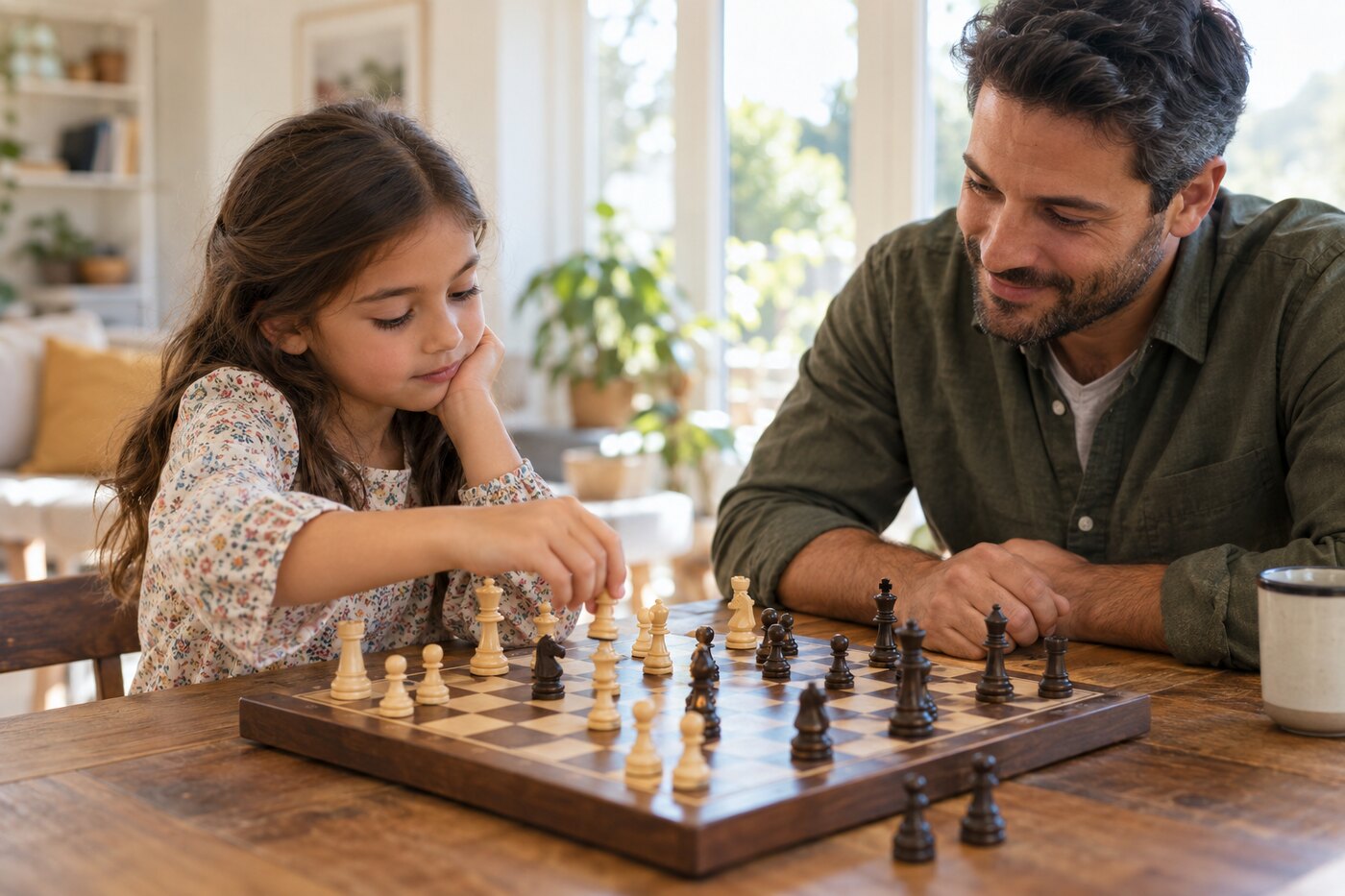
A child learning chess with her father at home; AI-generated illustrative image
- What can children practise through chess?
- Looking carefully before acting
- Planning—and changing the plan
- Remembering meaningful patterns
- Waiting, taking turns and handling disappointment
- Explaining an idea to another person
- What does research say about brain and school benefits?
- A gentle way to teach your child chess
- What age is a good time to begin?
- Keep the game from becoming another exam
- How can you tell whether it is worthwhile?
- Sources
Teaching a child chess gives them a playful place to practise planning, paying attention and thinking before moving. Those are worthwhile experiences—but they are not proof that chess raises IQ or guarantees better school results. The best reason to start is simpler: your child might enjoy learning how to think through a challenge with you.
Picture a beginner reaching for a queen because an unguarded pawn looks tempting. Before the move, ask: “What could happen to your queen next?” That small pause is the heart of a good chess lesson. You are not asking for brilliance. You are making room for a second thought.
What can children practise through chess?
The benefits below describe opportunities within the game, not guaranteed changes in a child's brain or behaviour outside it. How you teach matters: a relaxed conversation offers a very different experience from an adult criticising every mistake.
Looking carefully before acting
A position changes after every move. A child has to notice the change, check which pieces are threatened and choose where to focus. Instead of saying “Concentrate!”, try one specific question: “Which of your pieces could be captured?” Give them time to look. Finding one threat independently is a more useful beginner goal than playing a flawless game.
Planning—and changing the plan
Chess invites children to compare options: capture a piece, protect their king or develop a piece that has not moved. Ask them to name two possible moves and explain one difference. When the opponent disrupts their idea, discuss a new plan. The lesson is not that planning prevents surprises; it is that a plan can be revised.
Remembering meaningful patterns
Beginners remember how pieces move, then start recognising familiar arrangements. You can revisit a simple position from yesterday and ask what they notice today. Keep the goal narrow: recognising a chess pattern is progress in chess. It does not establish that homework, spelling or everyday memory will automatically improve.
Waiting, taking turns and handling disappointment
A board game creates a setting to practise waiting for someone else, following shared rules and responding to an unwanted result. A lost rook can feel enormous to a child. Acknowledge the feeling before analysing the move: “That was frustrating. Shall we take a break or look at one different move?” Learning should not depend on swallowing every emotion.
Explaining an idea to another person
“I moved here because…” can start a lovely conversation. Take turns explaining your thinking, including your own mistakes. Ask permission before coaching during a game; sometimes a child wants an opponent, not a running commentary. Listening to their explanation also helps you see whether a rule is unclear or a position is simply too difficult.
What does research say about brain and school benefits?
A large Education Endowment Foundation trial involving 100 English schools and 4,009 pupils found no improvement in mathematics, reading or science test attainment one year after the chess programme ended. This finding does not mean children cannot enjoy or become skilled at chess; it limits what parents should promise about school results.
A 2017 research discussion by Sala, Foley and Gobet describes promising earlier results but important weaknesses, including a lack of comparisons with other engaging activities. Becoming better at chess and becoming better at unrelated tasks are different claims. Evidence for the second is not strong enough to sell chess as a general intelligence booster.
For a family, the practical conclusion is to offer chess as an enjoyable learning activity—not brain treatment, an IQ programme or a replacement for reading, movement, sleep and ordinary play.
A gentle way to teach your child chess
You do not need to be a strong player. Learn alongside your child, admit when you need to check a rule, and use short activities rather than a lecture about all 32 pieces.
- Start with one piece. Put a rook on an otherwise empty board and explore straight-line moves. Then try a bishop. Introduce the knight separately rather than asking a beginner to remember everything at once.
- Use a small challenge. Ask how a rook could reach a chosen square without jumping over another piece. A clear task gives the child something manageable to solve.
- Build towards a full game. Add the king and explain check, then introduce the remaining rules gradually. Do not expect the first session to cover castling, promotion and every exception.
- Keep early sessions brief. As a practical starting point, try 10–15 minutes and stop earlier if interest fades. This is a flexible family suggestion, not a scientifically established dose for cognitive improvement.
- Review one moment. After playing, choose one move the child is proud of and one position to explore. Avoid replaying every error.
A useful prompt before a move is: What changed? What is threatened? What might happen next? Model the questions aloud occasionally, then give your child space to use them without being tested every turn.
What age is a good time to begin?
There is no deadline and no need to keep up with another family's prodigy. Look for interest in the pieces, willingness to take turns and curiosity about simple rules. A younger child may prefer moving one piece around; an older beginner may be ready for a full game. Match the activity to the child in front of you, not to an impressive age on a social-media video.
Keep the game from becoming another exam
- Praise a specific choice—spotting a threat or explaining a plan—rather than calling the child a genius.
- Agree whether this is a teaching game with take-backs or a game played to the finish.
- Avoid timed games until your child wants that extra challenge.
- Do not compare siblings' ratings or make winning a condition for praise.
- If playing online, choose age-appropriate settings, supervise use and restrict contact with strangers.
If chess regularly brings tears, arguments or dread, make the sessions easier, shorter or less frequent—or choose another game. Persistent attention or learning difficulties deserve appropriate professional support; chess is not a substitute for assessment or treatment.
How can you tell whether it is worthwhile?
Look for small, observable changes: your child asks to play again, remembers a rule, notices a threatened piece or explains a choice without prompting. These are useful signs of engagement and learning the game, not a home-made intelligence test. You can also ask, “What was fun today?” The answer may tell you more than the score.
Bottom line: teach chess because the thinking and the time together can be rewarding. A child who enjoys pausing, exploring a possibility and trying again is getting something valuable from the board—even without a trophy or a promise of higher grades.
For another low-pressure family learning habit, see our guide to building a reading habit.