Petrol, Hybrid or Electric? A Practical Car-Buying and Running-Cost Guide
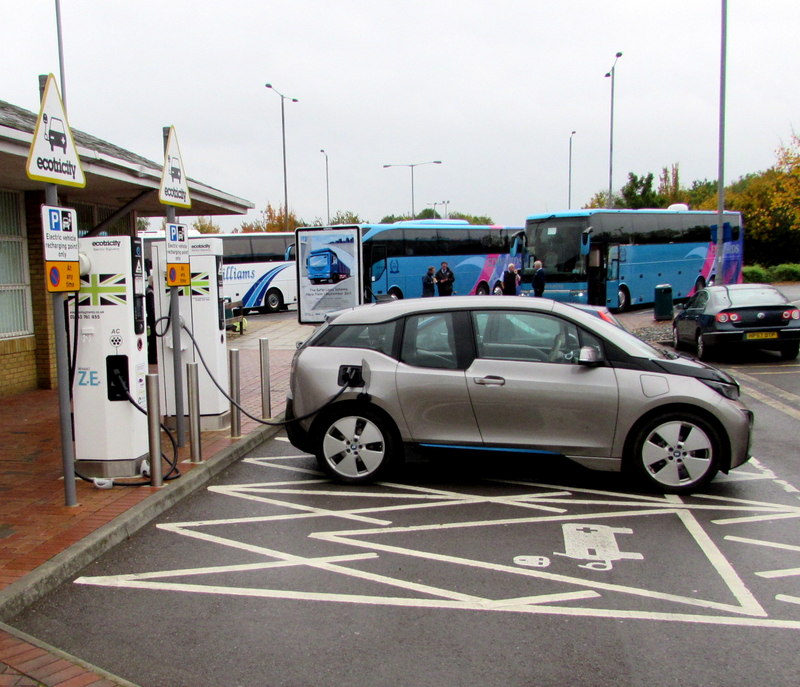
Electric car charging in the UK. Jaggery / Geograph, CC BY-SA 2.0.
- The short answer, before the detail
- 1. What changes under the bonnet?
- Petrol: a fuel tank and a combustion engine
- Full hybrid HEV: petrol plus electrical assistance, without a plug
- Plug-in hybrid PHEV: two energy sources, one important habit
- Battery-electric BEV: no petrol backup
- 2. A practical comparison—not invented star ratings
- 3. Running costs: an example you can change
- 4. Cheap energy is not the same as cheap ownership
- 5. Charging and range: think about your schedule
- 6. Lebanon: parking and electricity are part of the purchase
- 7. Maintenance and the used-car battery question
- 8. Environmental impact: look beyond the exhaust
- 9. Dajran’s evaluation by driver, not by badge
- 10. Questions before paying a deposit
You walk into a showroom asking for a car that will save money. You leave with four acronyms, three promises and someone insisting their favourite technology is the future. The useful question is less glamorous: which car can you fuel, maintain and afford in your actual life?
This guide compares petrol, conventional full hybrid (HEV), plug-in hybrid (PHEV) and battery-electric (BEV) cars. It offers a decision method, not a universal winner or a model endorsement. This is desk research using the official sources linked below, not a hands-on vehicle test. Sources reviewed on 3 October 2026.
The short answer, before the detail
Reliable, reasonably priced charging and a parking space? Take an EV seriously. No charging and plenty of traffic? Compare a full hybrid with an equivalent petrol car. Daily charging, short regular trips and occasional long journeys? A PHEV may fit. Strict purchase budget and little driving? A sound petrol car may cost less overall, despite using more fuel.
These are Dajran’s conditional recommendations, not a claim that every vehicle in one category beats every vehicle in another. Compare similar size, equipment and age. A small hatchback versus a large SUV is not a fair test of powertrain technology.
1. What changes under the bonnet?
Petrol: a fuel tank and a combustion engine
Fuel combustion powers an engine, which sends power to the wheels. There is no external charging requirement, but there are engine and exhaust-system maintenance needs. See AFDC’s official petrol-car explanation. Its practical appeal is that buying one does not depend on a socket beside your parking space. Reliability, however, depends on the particular model and its condition—not simply the word “petrol”.
Full hybrid HEV: petrol plus electrical assistance, without a plug
An HEV combines a combustion engine, electric motor and battery. The engine and regenerative braking recharge the battery; you do not plug it in. See the official HEV explanation. “Self-charging” does not mean free energy: fuel or recoverable movement supplies the energy.
Do not confuse this with a mild hybrid. A mild system assists the engine but cannot propel the car on electricity alone. A full hybrid can do so for limited distances and under suitable conditions. AFDC distinguishes the systems. Ask what is actually installed, rather than relying on the badge.
Plug-in hybrid PHEV: two energy sources, one important habit
A PHEV has a fuel engine and an externally rechargeable battery. It can use electricity for suitable journeys and fuel when needed. Depending on its design and conditions, the engine may run even while charge remains. Read how PHEVs work. Ask for electric range, charging capability and fuel consumption with the usable plug-in charge depleted—not just an impressive blended headline figure.
Battery-electric BEV: no petrol backup
A BEV runs on electricity stored in its traction battery and replenished externally. There is no petrol engine to rescue a trip when energy runs out. AFDC explains the components. For a buyer, the first question is not its acceleration time. It is where you will charge on an ordinary Tuesday evening.
2. A practical comparison—not invented star ratings
| Question | Petrol | Full HEV | PHEV | BEV |
|---|---|---|---|---|
| External charging? | No | No | Important to use its plug-in capability | Essential |
| Combustion-engine servicing? | Yes | Yes | Yes | No combustion engine |
| Check before buying | Condition and consumption | Condition and hybrid system | Both systems and charging routine | Battery, charging and repair support |
| When no charger is available | Refuel | Refuel | Use fuel; check consumption | Find another charger or change the trip |
3. Running costs: an example you can change
The following prices and consumption figures are Dajran’s educational assumptions, not current Lebanese tariffs, petrol prices or specifications for a particular car. Assume 15,000 km annually, petrol at $1.20 per litre, a petrol car using 7 L/100 km and an HEV using 5 L/100 km. For the BEV, assume 18 kWh/100 km measured at the electricity meter, including charging losses. Do not add losses a second time.
- Petrol: 150 × 7 × $1.20 = $1,260 per year.
- HEV: 150 × 5 × $1.20 = $900; fuel savings of $360.
- BEV at $0.20/kWh: 150 × 18 × $0.20 = $540.
- BEV at $0.40/kWh: $1,080.
- BEV at $0.60/kWh: $1,620—more than petrol in this example.
“Electricity is cheaper” is therefore not a calculation. The BEV’s energy-only break-even electricity price against petrol here is $8.40 ÷ 18 ≈ $0.467/kWh. Against the HEV, it is $6 ÷ 18 ≈ $0.333/kWh. Include session and parking charges for public charging. If you use several electricity sources, weight the average price by the energy purchased from each; do not simply average unrelated tariffs.
A PHEV example: suppose 70% of annual distance is electric at 18 metered kWh/100 km, the remainder uses petrol at 6 L/100 km, and electricity costs $0.20/kWh. Electricity costs $378 and petrol $324, making $702 annually. With no charging and all distance at the assumed petrol-mode consumption, it costs $1,080. This is a simplified scenario: actual consumption and the electric share vary. It is not a savings promise.
4. Cheap energy is not the same as cheap ownership
Write a five-year calculation: purchase price + finance + energy + servicing and repairs + insurance and fees + charger installation − resale value. Do not also add depreciation if you have already subtracted resale value. Get real quotations for two specific vehicles, particularly insurance, repair support and warranty coverage.
If an EV costs an extra $4,000 and saves $720 annually on energy in the first scenario, the purchase premium takes roughly 5.6 years to recover from energy alone. An assumed $2,000 HEV premium with $360 annual fuel savings also takes about 5.6 years. This simple calculation excludes financing, maintenance and resale differences; it is not a financial forecast. Halve the distance and annual energy savings halve, approximately doubling that payback period.
That changes the conversation for low-mileage owners. Paying more to save on every kilometre is not automatically worthwhile if you drive very few kilometres. Conversely, a frequent driver should not dismiss a higher purchase price without doing the annual calculation.
5. Charging and range: think about your schedule
An advertised range is not a guarantee for your route. Terrain, loads and heating or air conditioning deserve an additional buffer, as AFDC’s consumer guide explains. Record a normal week and your longest regular trip. Check actual charging locations, opening hours, prices and compatible connectors—not just dots on a map.
A simple illustration: 50 km at 18 metered kWh/100 km needs 9 kWh. At a steady, actual 3 kW, replacing that energy takes about three hours. This is not a full-battery charging time, and delivered power may vary. kW measures power; kWh measures energy. A charger’s peak rating is not a promise of constant power throughout a session.
Before buying charging equipment, have a qualified electrician assess capacity, earthing, protection, wiring and supply. AFDC’s home-charging guidance stresses certified equipment and electrical-capacity checks. Follow the vehicle’s instructions and local rules. American voltage and charging-level terminology is not an installation recipe for Lebanon. Do not improvise with ordinary extension leads.
6. Lebanon: parking and electricity are part of the purchase
The World Bank describes electricity-sector challenges and a project to restore grid services. That is background, not proof of today’s supply hours at your address. Check your actual reliability and cost: grid, generator subscription, solar or public charging?
Get building approval for parking, wiring and billing. Solar panels do not mean unlimited free charging. Will the car be present during generation? What surplus remains after household demand, and can the system handle the load? Do not buy based on a promise that charging will be available “soon”. Try the charging plan before committing to the car.
7. Maintenance and the used-car battery question
AFDC’s maintenance guidance says BEVs generally need less scheduled maintenance, while HEVs and PHEVs retain combustion-engine requirements. Less is not zero: budget for tyres, suspension, cooling and the low-voltage battery too. Separate routine servicing from an unexpected major repair.
Do not buy a battery based on a dashboard range photograph. Request a specialist battery-health report, accident and water-damage history, diagnostic checks and a charging test. Get written confirmation of local warranty validity, transferability, time and mileage limits, and capacity-loss conditions. An imported vehicle’s original-market warranty is not automatically local protection.
This is a buyer’s checklist, not a standardised battery test: who repairs the system locally, can they repair parts or only replace assemblies, what might a repair cost, and how long would parts take? There is no universal replacement-battery price in this guide. Do not open a high-voltage system yourself.
8. Environmental impact: look beyond the exhaust
EPA explains that EV lifetime greenhouse-gas emissions are typically lower than those of comparable petrol vehicles, including manufacturing and electricity. Electricity source and vehicle size matter. We cannot transfer a U.S. estimate to a generator-powered household without local analysis. No tailpipe does not mean no environmental impact.
9. Dajran’s evaluation by driver, not by badge
- Daily traffic, no charging: start by comparing a full HEV with an economical petrol car. Test whether fuel savings justify the premium.
- Private parking, dependable charging: a BEV is a strong candidate if range, repair support and budget fit.
- Short routine trips, daily charging, occasional long journeys: consider a PHEV, provided plugging in becomes a real habit.
- Little driving, strict purchase budget: do not dismiss a sound petrol car because its consumption is higher.
- Frequent, unpredictable long trips: prioritise convenient energy supply. Do not select a BEV without checking fallback routes.
10. Questions before paying a deposit
Must a battery be replaced every few years? That is not a general rule; condition, lifespan and warranty differ. Is a PHEV useful without charging? It may operate, but compare its petrol-mode consumption with an HEV rather than expecting electric savings. Is a hybrid always better? No: purchase premium, distance and vehicle condition can reverse the decision.
Write down annual distance, electricity source and price, insurance and servicing quotes, local warranty conditions and a test drive on your actual route. Then choose. The car that works on an ordinary day matters more than the car that wins an internet argument.
Cover: an EV charging at Reading Services, UK, in 2015; a contextual photograph, not a model test or a Lebanese charging site. Photo by Jaggery / Geograph, CC BY-SA 2.0, image file unchanged. This is general guidance, not a recommendation to buy a specific vehicle. Illustrative prices are not commercial quotations.
