Why Do Cats Like Boxes? Your Cat Has Reviewed the Packaging
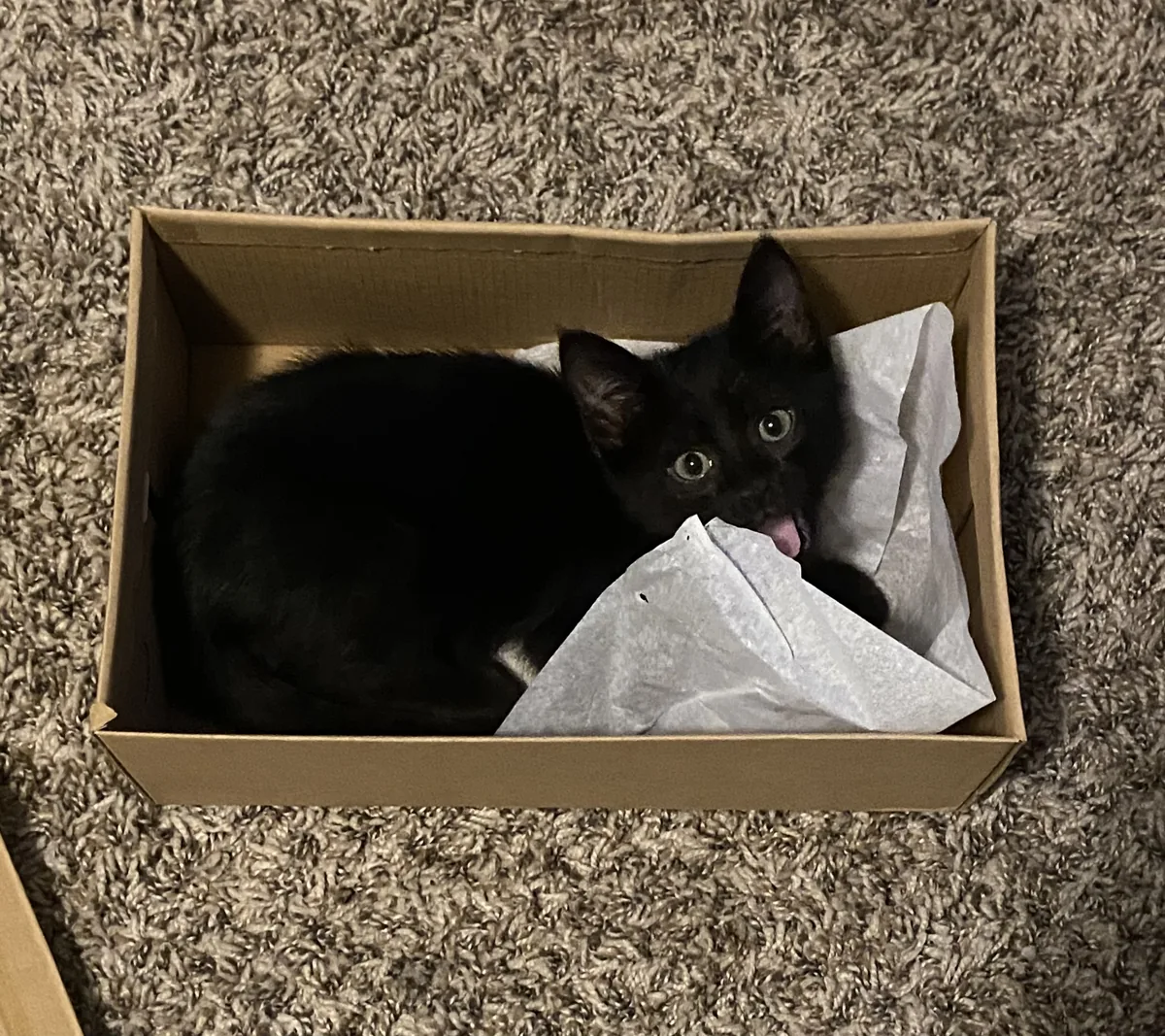
Black cat in a cardboard box. Illustrative photograph, not from the study. Catboy69 / Wikimedia Commons, CC0.
You buy the comfortable bed. You remove the packaging. Your cat moves into the packaging. Somewhere between checkout and the living room, the cheapest part of the purchase has become the main attraction.
Why do cats like boxes? A useful answer starts with what a box offers, rather than what it costs: an enclosed place to retreat, a new object to investigate and a little distance from whatever is happening outside. That does not mean every cat wants the same box—or that ignoring an expensive bed is a personal insult.
A hiding place, not a review of your shopping choices
Feline Veterinary Medical Association guidance identifies a safe retreat as an important environmental need. A cardboard box is one possible option. The point is that the cat can choose to withdraw from contact, not that cardboard has a mysterious power over every feline.
Notice the difference between “my cat can go somewhere quiet” and “I put my cat somewhere quiet.” The first gives the animal a choice. The second may turn the hiding place into somewhere it wants to escape.
What the research actually tells us
A randomized study published in PLOS ONE examined hiding boxes for cats newly arriving at a Dutch shelter during a 12-day quarantine period. The researchers found a benefit in the behavioral stress measure for cats given boxes, but the boxes did not prevent weight loss. The study concerns shelter conditions; it does not prove that every household cat likes every box, or that a cardboard hideout treats a medical problem.
That is a more useful conclusion than “science proves cats prefer cheap things.” It supports offering a retreat while leaving room for individual preference and context.
Build a cardboard corner, not a cat obstacle course
For a first try, keep the project deliberately boring: a clean, stable cardboard box on the floor in a quiet spot. Remove loose tape, staples, strings and packaging pieces. Avoid containers that held chemicals or have an unknown residue. Do not close the lid on the cat. Provide an easy way in and out, and check that the box cannot tip or trap the animal.
This is an editorial setup checklist, not a substitute for veterinary advice or a tested product recommendation. If your cat chews and swallows cardboard or other non-food material, remove the material and ask your veterinarian for advice. The joke is about the shopping bag—not about ignoring a potential problem.
A small observation game you can try
Place the box without placing the cat inside it. Leave its usual bed available. Over a few quiet periods, note whether the cat approaches, looks in, sits nearby, enters or ignores it. Avoid calling it over repeatedly or offering a treat every time it enters if you want to observe its unprompted choice.
Use a simple note: time, location, household activity and what the cat did. If you move the box, change only its location. Moving it while also changing the blanket and adding toys makes it difficult to know what mattered. This is a casual observation, not a scientific experiment or a way to score your cat.
If the box loses, the cat has not failed
A cat may prefer its familiar bed, a carrier it already likes or another resting place. You do not need to stack more boxes around it until it cooperates. Keep useful options, remove clutter and stop if the new setup seems to bother the animal.
Nor does using a box mean a cat is necessarily distressed. A funny photograph is not enough to diagnose stress. A sudden change in hiding, eating or normal behavior deserves attention; do not let a cute explanation replace a conversation with a veterinarian.
The takeaway
The next delivery can bring you a purchase and your cat a possible hideout. Offer it safely, let the cat decide, and resist the urge to print a five-star review on its behalf.
Before adopting a cat, read our guide to the benefits and trade-offs of cat ownership. For a completely different feline surprise, meet the record-holding cat with 29 toes.
Sources
- PLOS ONE: hiding boxes, behavioral stress and body weight in shelter cats
- Feline Veterinary Medical Association: environmental needs and safe places
Image credit
Illustrative photograph: Catboy69 / Wikimedia Commons, under CC0. Resized and converted to WebP.