Small-Room Mirrors: Why Yours Might Be Doubling the Clutter
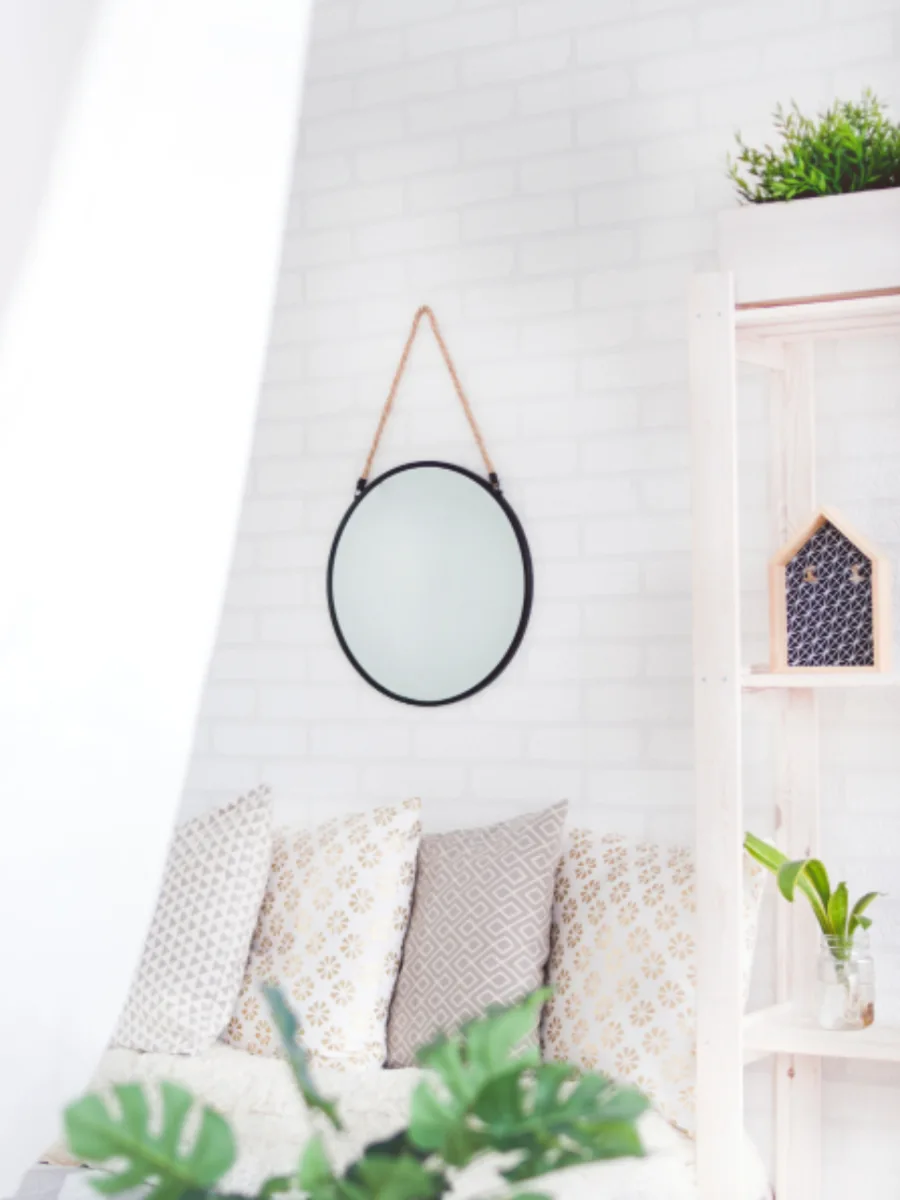
Round wall mirror above a seating corner with cushions and plants. Illustrative photograph, not a before-and-after test. Studio 7042 / StockSnap, CC0.
You add a mirror to make the room feel bigger. Now the pile of laundry appears in two places. Technically, the mirror is doing its job. Your room simply has not received the result you wanted.
A mirror changes what you see, not the floor plan. That is why placement matters more than the promise on a product page. Before buying another one, look at the scene your current mirror is returning to the room.
Start with the reflection, not the empty wall
Stand where you usually enter or sit. What fills the mirror: a window, a calm wall, a lamp, a busy shelf or the television? Repeat the check from a second everyday position. A reflection that looks attractive from the doorway may feel distracting from the sofa.
IKEA’s mirror guide describes using reflected light and depth as part of a room’s visual effect. Treat that as a placement idea, not a promise that a mirror adds usable space. The passage between your chair and table stays exactly as wide as it was.
The no-purchase reflection audit
Try these questions before choosing a size or shape:
- Which area do I want to draw attention to?
- What will appear behind me in the reflection?
- Will the mirror reflect a light source into my eyes?
- Does furniture block the view or the walking route?
- Can the mirror be installed safely on this surface?
Write down the main problem in one sentence. “The room feels dark when I read in this chair” is a clearer task than “the room needs a wow factor.” You may need a better lamp or a clearer window before you need a mirror.
Try one change—and use the same camera position
Choose a viewpoint and take a reference photograph using a normal camera setting, not an ultra-wide mode. Put a removable marker at the camera position so you can repeat the framing. Keep the time of day and lighting similar.
Then change one thing: clear the reflected shelf, move a small lamp or adjust an existing safe mirror position. Take another photograph from the marker. Compare the visible objects and the ease of moving through the room, not just which picture looks more dramatic.
This is a suggested home comparison, not a renovation we have performed or a controlled design study. Different camera lenses and a brighter afternoon can make a supposed “after” look impressive without demonstrating an actual improvement.
A mirror cannot tidy the second version of your room
If a reflection repeats clutter, choose what you want visible before relocating the mirror. It may be enough to clear one surface or move a frequently used storage basket out of the sightline. The goal is not to hide everyday life from photographs; it is to make the view useful from where you live.
Small-room furnishing guidance also emphasizes functional layout and storage. A mirror is one option within that larger problem. If a cupboard cannot open or a walking route is obstructed, address that first rather than trying to make the obstruction look farther away.
Keep the room you actually enjoy
Not every small room needs to appear enormous. A cozy reading corner, a colorful wall or a compact arrangement can be exactly right for its use. Ask whether the room feels comfortable and works for your routine, rather than whether the photograph looks like a hotel lobby.
If you prefer a softer Mediterranean mood, pair restrained materials and a calm arrangement with the ideas in our guide to modern Mediterranean design and soft arches. An arch is not a requirement, and neither is a shopping list of new furniture.
Safety before the photograph
Follow the mirror manufacturer’s mounting instructions and use fittings suitable for the wall. Do not improvise a leaning arrangement that could topple, especially around children or pets. If the mirror is too heavy to move safely, photograph its current reflection and test changes to the objects in view instead.
The takeaway
Before asking “where can I put a mirror?”, ask “what do I want it to reflect?” Sometimes the winning design move is a better position. Sometimes it is clearing the laundry. Both are more useful than buying a second reflection of the same problem.
Sources
- IKEA: decorating with wall mirrors
- IKEA: practical layout and furnishing ideas for very small living rooms
Image credit
Illustrative photograph: Studio 7042 / StockSnap, under CC0. Resized and converted to WebP.