How to Measure Curtains Before Buying: Width, Drop and Fullness
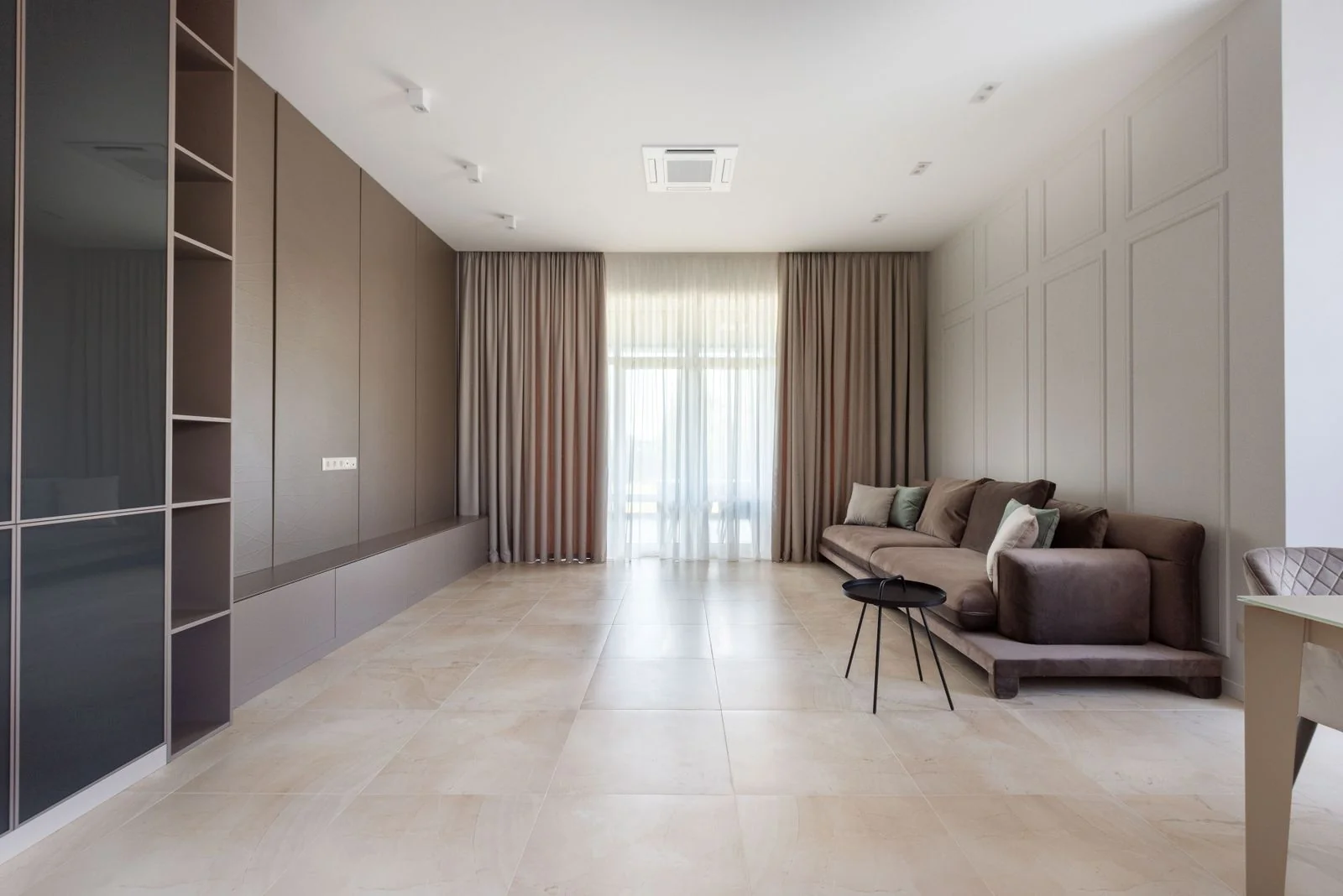
Layered curtains in a living room; inspiration, not a fitting template. Max Vakhtbovych / Pexels, Pexels License.
- Start with the job, not a fabric swatch
- Choose the hanging system before the final measurement
- Keep three measurements separate
- Understand panel width and fullness
- Test the lower edge against real life
- Check fabric in both daytime and evening light
- Include safety and care in the purchase
- Your ready-to-shop record
- Image and usage credit
The most expensive curtain mistake can happen before you choose a fabric: you measure the window, order the panels and discover that the finished curtains are too narrow, too short or in the way of a door. A good-looking photograph cannot tell you where your curtain actually needs to start and finish.
Measure curtains for the chosen hanging system and the way you use the room—not just the glass. Decide on light, privacy and daily access first; then separate the width, drop and fabric-fullness measurements. This guide is a buying checklist, not instructions for drilling or modifying a wall.
Start with the job, not a fabric swatch
Write one sentence describing the problem: “I want daylight without exposing the sitting area,” “I need less glare while watching television” or “the balcony door must remain easy to use.” If you cannot state the job, you may be comparing fabrics that solve different problems.
Consider when you use the space. A room used mostly in the evening needs a different privacy check from one you photograph in bright daylight. Do not assume that a fabric hiding the view in one lighting condition will do so in every other condition.
Choose the hanging system before the final measurement
A pole with rings, an eyelet curtain and a track do not necessarily share the same measurement starting point. Decide which you will use, then follow the selected product’s instructions. Check how much space the hardware and gathered fabric need.
IKEA’s window-measuring guide begins with mounting position and accounts for nearby windows, furniture and radiators. Use that principle before choosing the drop. A proposed mounting position is not a guarantee that your wall can safely support the fitting.
For rented homes, confirm permission and obtain suitable installation advice before ordering a system that depends on new fixings. A heavy fabric and hardware combination is not a sensible place to improvise.
Keep three measurements separate
- Window dimensions: the opening you are covering and any projecting sill, handle or frame.
- Pole or track coverage: the actual span available to close and open the curtain, according to the hardware instructions.
- Finished drop: the distance from the appropriate hanging reference point to the intended lower edge.
Record centimetres or inches consistently. Label every number rather than writing “180” on a shopping note and relying on memory. Measure both sides and the middle where relevant; an uneven floor or ceiling can reveal a difference you did not notice by eye.
Understand panel width and fullness
John Lewis’s curtain guide distinguishes headings and measurement methods. Follow the instructions for the exact curtain type, and check whether a listed width refers to one panel, a pair or finished coverage. These labels are not interchangeable.
Here is an invented arithmetic example: if a supplier specifies total flat fabric width of twice a 180 cm track, the target is 360 cm. Two panels measuring 140 cm each give 280 cm, so they would not meet that supplier’s stated target. Twice the width is the example’s assumption, not a universal rule for every fabric or heading.
This is why “two panels” tells you very little without their dimensions. Ask the retailer to confirm the required quantity for the chosen system before ordering, especially for made-to-measure goods.
Test the lower edge against real life
Floor-length curtains can be an attractive option, but a photograph does not show your radiator, pet, robot vacuum or balcony-door routine. A fabric puddle may look decorative and still be inconvenient in the room you use every day.
Use a paper marker or hold a sample at the intended ending point. Open the door fully, check the window handle and consider how you will clean beneath the fabric. Keep heating equipment, ventilation and exits unobstructed, following the relevant equipment instructions rather than guessing a safe clearance.
Check fabric in both daytime and evening light
Request a sample if possible. Hold it in the actual window position and compare it beside your wall and sofa. Check how it looks when room lights are on, not only when the sun makes the fabric glow.
If privacy is the main job, ask another household member to help assess visibility safely from an appropriate public-facing position. Do not assume a tiny swatch replicates a complete installed curtain. For products claiming blackout performance, read the product description and consider edge gaps as well as the fabric.
Our living-room lighting guide can help you evaluate the room after dark. If furniture blocks the window or curtain movement, revisit the small-room layout before shopping.
Include safety and care in the purchase
The US Consumer Product Safety Commission warns about window-covering cord strangulation hazards and recommends cordless coverings where young children live or visit. Inspect the complete system, not just the fabric, and follow installation and safety instructions.
Also check washing, drying and hemming instructions before altering a panel. Do not assume every fabric can be machine-washed or shortened with the same method. Ask about returns before cutting, washing or commissioning custom work; policies vary.
Your ready-to-shop record
- Purpose: daylight, privacy, glare control or a combination.
- Selected hanging system and confirmed measurement reference point.
- Window, hardware span and finished drop, with consistent units.
- Width definition, required fullness and number of panels.
- Clearance for doors, furniture, heating and safe operation.
- Care method, installation requirements and total cost.
Buy after the measurements make sense. A modest curtain that opens easily and solves the right problem is a better result than a dramatic one you fight with every morning.
Both photographs are illustrative, resized and converted to WebP under the Pexels License. They do not imply photographer endorsement.
Image and usage credit
Layered curtains in a living room; inspiration, not a fitting template. Max Vakhtbovych / Pexels · Pexels License Resized and converted to WebP; use does not imply the creator’s endorsement.