Cat Body Language: The Slow Blink, the Belly Trap—and What to Do Next
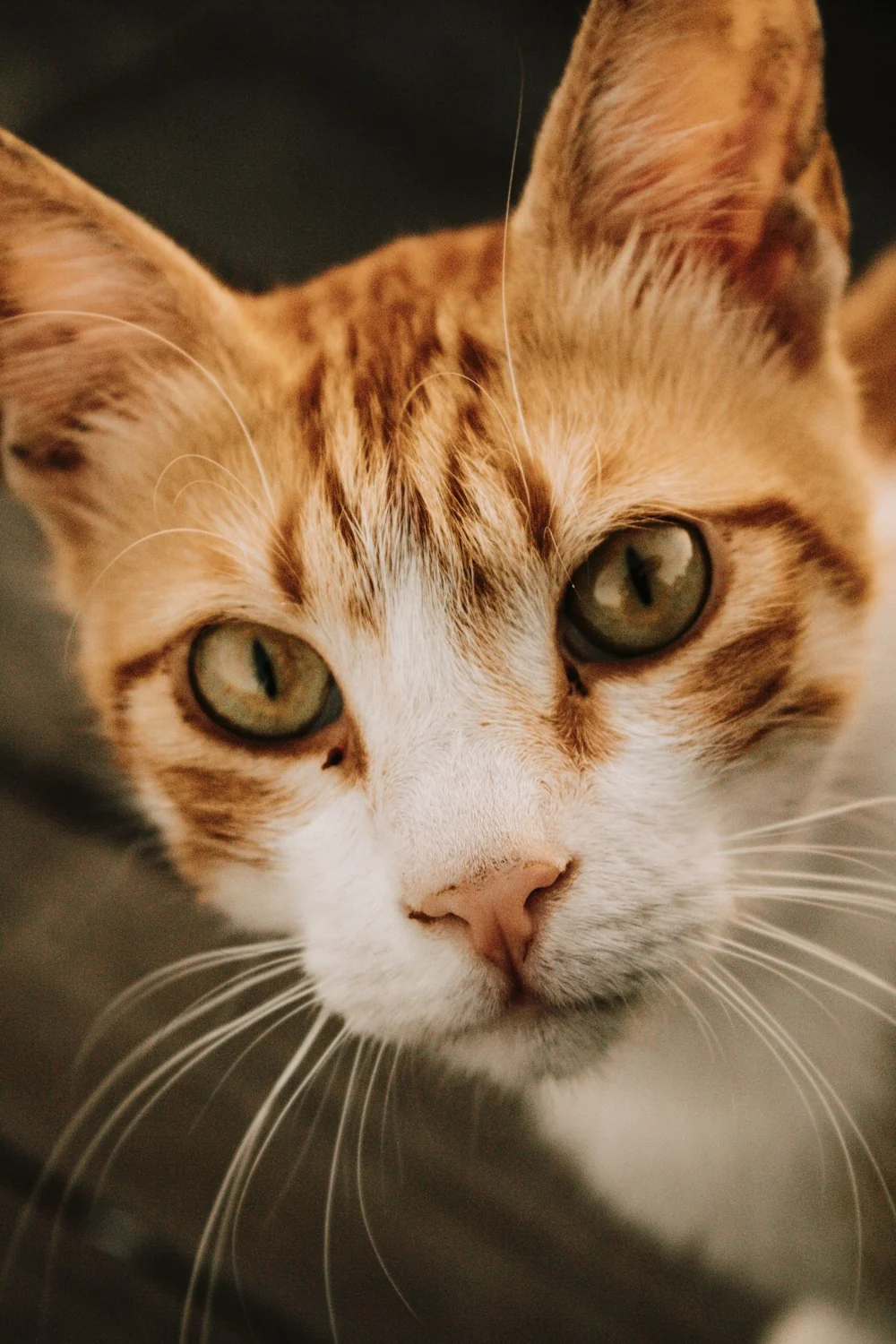
An orange and white cat in close-up; an illustrative Dajran photograph choice, not evidence of the cat's mood. Merve Şahin / Pexels, Pexels License.
- Start with the whole cat, not one adorable detail
- The slow blink: an interesting finding, not a love detector
- The belly-rub misunderstanding
- The tail and ears: read the sentence, not a single letter
- Purring: lovely to hear, incomplete as evidence
- A gentler interaction: let the cat do some of the choosing
- Try a tiny observation notebook—not a cat personality test
- When a change needs a vet, not another internet explanation
- The best takeaway: curiosity without mind-reading
- Image and usage credit
Picture this: your cat rolls onto its back, looks ridiculously cute, and you reach for the fluffy belly. A paw intercepts your hand. A moment ago this looked like an invitation. Now you are negotiating with a very small security guard.
That imagined scene captures the problem: we often translate a cat's movements into what they would mean if a person—or a dog—did them. A more useful question is not “Does my cat love me?” but “What is happening right now, and what should I do next?” This guide is about reading cat body language without turning every blink into a grand declaration.
Start with the whole cat, not one adorable detail
A loose posture, an upright tail and comfortable-looking ears together suggest a different situation from a tense body with flattened ears. Read the combination and the setting, rather than assigning one fixed meaning to a single movement. Cats Protection's body-language guide explains these clusters of signals.
Think of a photo caption. “Cat by the window” is an observation. “Cat is furious because I bought the wrong curtains” is a screenplay. The second is much more entertaining, but it isn't necessarily useful.
Before interpreting a moment, ask three questions:
- What happened just before it: a visitor arrived, you reached out, or nothing obvious changed?
- What can you actually see—not what have you guessed?
- Is this familiar behaviour for this particular cat, or something new?
That distinction between observation and interpretation will help throughout the guide.
The slow blink: an interesting finding, not a love detector
A 2020 study in Scientific Reports used two small experiments to investigate eye narrowing between cats and people. Cats showed more of these eye movements after owners slow-blinked; in the second experiment they were more likely to approach an unfamiliar person following a slow-blink interaction than the control condition. That supports a role in positive communication. It does not measure love or guarantee that every cat will respond.
Keep that difference in mind when watching those irresistible “my cat blinked back” videos. A small observation can be delightful without being a scientific certificate of your relationship. And a cat that doesn't respond hasn't failed an affection exam.
The belly-rub misunderstanding
A visible belly is not automatic permission to touch it. Many cats dislike belly petting, although individuals differ. Letting the cat approach, and noticing whether it chooses to stay, is more useful than treating a pose as an invitation. Cats Protection's petting advice makes that distinction.
So the fluffy belly can remain a magnificent thing you admire without acquiring. You don't need to touch every appealing surface in the room. Nobody expects you to stroke the velvet curtains either.
The tail and ears: read the sentence, not a single letter
A lashing tail can accompany annoyance; ears drawn back or flattened can appear in defensive or fearful states. These are reasons to reconsider an interaction, not invitations to prove the cat will tolerate more. The University of Edinburgh veterinary body-language handout describes these signals and stresses context.
Imagine you are petting a cat and its body becomes tense, its ears flatten and its tail starts lashing. The useful next step is to stop and give it room, rather than confidently announce “It is wagging because it likes this.” You don't need an exact translation to choose a less intrusive response.
Purring: lovely to hear, incomplete as evidence
Purring can occur during comfortable moments, but also with stress or pain. A purr alone doesn't settle the question of how a cat feels. Cats Protection's explanation of purring is a useful reminder not to use the sound as an all-clear.
This isn't a reason to worry about every contented evening on the sofa. It is a reason to resist absolute rules. “It purred, so everything is fine” and “It purred, so something is wrong” make the same mistake: both ignore the rest of the situation.
A gentler interaction: let the cat do some of the choosing
When a comfortable cat approaches, try a gentle cheek or chin stroke, then pause. Does it choose to remain or move away? If it leaves, let it leave; don't follow to finish the cuddle. This follows the petting guidance above.
The pause changes your aim from “get more affection” to “make this interaction work for both of us.” It's also an easy idea to explain to a child: the cat gets a turn to choose. Success doesn't need to look like a cat sitting on command; it can look like an uneventful moment that ends without a struggle.
Try a tiny observation notebook—not a cat personality test
For a few ordinary, undisturbed moments this week, write down the situation in this format:
- Setting: where you were and what had just happened.
- Observation: a description someone else could recognise.
- Your response: what you did, including doing nothing.
- Next moment: what happened afterwards.
An example might be: “A visitor arrived. The cat went behind the chair. We stayed where we were. Ten minutes later, it came back into the room.” That's a record, not proof of why it moved. Don't stage uncomfortable situations for the notebook; ordinary life supplies enough material.
Compare that with “The cat hates our visitor.” The second sentence skips straight to a conclusion and gives you almost nothing useful to review. The notebook's job is better attention, not scoring your cat or discovering a secret diagnosis.
When a change needs a vet, not another internet explanation
New changes in appetite, movement, social interaction or hiding can be signs of discomfort. A normally sociable cat suddenly avoiding touch should not simply be labelled “moody.” International Cat Care's acute-pain guide explains why changes from a cat's normal behaviour matter. Contact your veterinary clinic if you suspect pain; this article cannot diagnose it.
If you do contact the clinic, plain observations are more helpful than a dramatic label. Explain what changed and when you first noticed it. The same careful attention that improves everyday interaction can help you describe a concern clearly.
The best takeaway: curiosity without mind-reading
You can enjoy the funny faces and still be careful about the story you attach to them. A good relationship doesn't require translating every twitch perfectly. It benefits from noticing, leaving room for uncertainty, and not making the cat participate in your preferred version of the moment.
For another practical next step, explore budget-friendly ways to enrich an indoor cat's day. And next time that wonderful belly appears, consider this translation first: “Excellent photo opportunity. Further terms and conditions unknown.”
Image and usage credit
An orange and white cat in close-up; an illustrative Dajran photograph choice, not evidence of the cat's mood. Merve Şahin / Pexels · Pexels License Resized and converted to WebP; use does not imply the creator’s endorsement.