Why Did I Come Into This Room? The Doorway Effect Explained
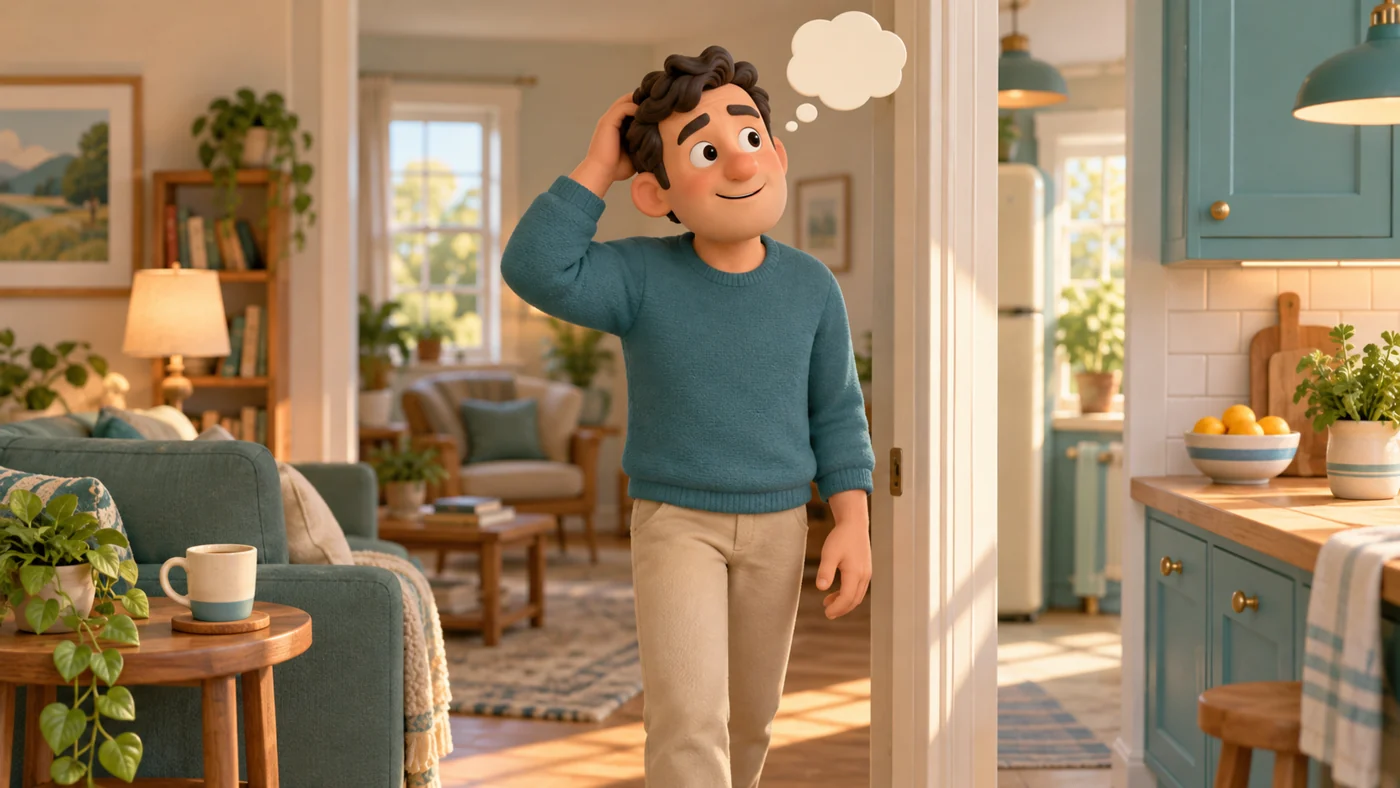
AI-generated editorial illustration of a puzzled man at a doorway; an imagined scene, not a photograph of a research experiment.
- Your day comes in scenes, even when nobody shouts “cut”
- What the classic research actually found
- The plot twist: not every doorway produces the same effect
- And “doors improve memory” needs qualifications too
- Is walking back a magic undo button?
- Three small supports that don't require “brain hacks”
- A one-day challenge: notice the handover
- Keep the funny explanation separate from a health concern
- The takeaway: a clearer mission, not a suspicious door
You get up to fetch something. You walk into the next room. You stop. The room is here. You are here. The mission has apparently resigned.
Imagine the rest of the scene: you inspect the fridge for clues, although you were looking for a charger. Then you return to the sofa with no charger and a snack. An unsuccessful expedition, but not a completely unproductive one.
Why do we sometimes forget why we entered a room? The doorway effect is one research idea behind that familiar moment. The interesting part is not that doors have mysterious powers. It is that changing situations can change how we access recently relevant information—and the evidence is more complicated than a viral headline suggests.
Your day comes in scenes, even when nobody shouts “cut”
Researchers study how we divide continuous experience into events: a conversation, a trip to the kitchen, the start of another task. A doorway can mark a boundary between those events. A 2026 virtual-reality study examined how these boundaries and distractions affected memory for where objects appeared and their order.
Think of moving between scenes in a film. The scene has changed, but the previous one has not necessarily been deleted. That is an analogy, not a literal picture of your brain filing documents. “The door wiped my memory” is wonderfully dramatic—and too definite.
What the classic research actually found
In experiments reported in 2011, researchers found a decline in memory associated with changing locations, using both virtual and real environments. These were controlled memory tasks, not an investigation of everybody's missing kitchen intentions. They show that spatial transitions can matter under particular conditions.
That last sentence is worth keeping. It explains why an interesting finding is not the same as a universal household rule. If an experiment asks people to recognise previously encountered items, we cannot quietly replace that task with “remember to pick up your charger” and assume the result will be identical.
The plot twist: not every doorway produces the same effect
A 2021 study involving four experiments did not find a general doorway-related increase in forgetting. In one experiment with an extra working-memory task, participants made more false recognitions after crossing a doorway. That points to interference under added load, not a simple “cross door, lose thought” switch. The authors questioned how reliably the earlier effect generalised to altered tasks.
This doesn't make the original question silly. It makes it a better question: what are people trying to remember, what else are they doing, and how is memory tested? Science becomes more useful when we keep those details instead of rounding every result into “research proves.”
And “doors improve memory” needs qualifications too
Another study published in January 2026 tested whether learning words across two rooms helped later recall. Across two experiments there was little evidence of an overall advantage. A benefit appeared near the event boundary in one experiment, but faded after a short delay involving movement through other rooms.
So neither “doors ruin memory” nor “use doorways to boost your brain” is a fair shortcut. The kind of information, the task and the timing matter. Please don't renovate your house on the strength of a catchy psychology headline.
Is walking back a magic undo button?
Not reliably. In the 2011 research, returning to the original room did not remove the memory decline in that task.
You can still pause and reconstruct your own situation: what were you doing just before you stood up? Looking for a cable? Reading a message? Preparing a drink? Treat that as a practical attempt to recover the thread, not a guaranteed scientific trick.
If walking back reminds you of the charger, excellent. If it doesn't, the sofa is not broken. You haven't failed to press a universal reset button; there isn't one established by this research.
Three small supports that don't require “brain hacks”
Cambridge University Hospitals' practical guide suggests repetition, notes or phone reminders, and a consistent place for everyday belongings. These are supports, not cures for a doorway effect.
- Give the mission a name. Try “charger from the desk” instead of a vague “I need something.” Repeat the short phrase if useful.
- Give the task an external home. Put an important intention in a brief note or reminder rather than relying only on keeping it in mind.
- Give ordinary objects a regular home. A consistent tray or drawer for essentials is less theatrical than a hunt through five rooms.
The winning system is the one you will actually use. A single note called “next” may suit you better than a colour-coded productivity dashboard that takes longer to maintain than the tasks themselves.
A one-day challenge: notice the handover
This is a small reflection exercise, not a memory test or a reproduction of a laboratory experiment. Before one ordinary move between tasks, finish this sentence: “Next, I'm going to ___ so I can ___.”
For example: “I'm getting the charger so I can finish the call.” The point is to make the next action clear, not to earn a better memory score. Don't deliberately distract yourself or invent stressful tasks to see what happens.
If you lose the thread during the day, make a tiny record: what you intended, what happened in between, and whether a note would have helped. One observation cannot prove a doorway caused it. But it can reveal an awkward handover in your routine that is worth simplifying.
You might find that your troublesome handover is not a physical doorway at all: a message interrupts the plan before you even leave the chair. That is an example to consider, not a claim that every phone notification works like the doors in these experiments.
Keep the funny explanation separate from a health concern
An amusing explanation of an everyday lapse cannot diagnose memory problems. The NHS advises seeking medical advice when memory problems keep happening or affect daily life. Don't use “it's just the doorway effect” to dismiss a worrying change, and don't diagnose yourself from one blank moment.
The takeaway: a clearer mission, not a suspicious door
The next time you stand in a room like an actor whose lines have vanished, you have a better story than “my memory is terrible.” You also have a more honest story than “the door definitely did it.”
Name the next task, leave a small reminder when needed, and stay curious about what actually interrupted the plan. If you enjoy the way small habits shape attention, try our guide to building a reading habit in a distracted world. And if you return with a snack instead of a charger, at least finish the original mission before commissioning a second snack expedition.
Cover disclosure: an AI-generated illustration created for this article, resized and converted to WebP. It does not depict a study participant or medical imaging.