That Curtain Isn’t Real: How Trompe-l’Oeil Art Fools Your Eyes
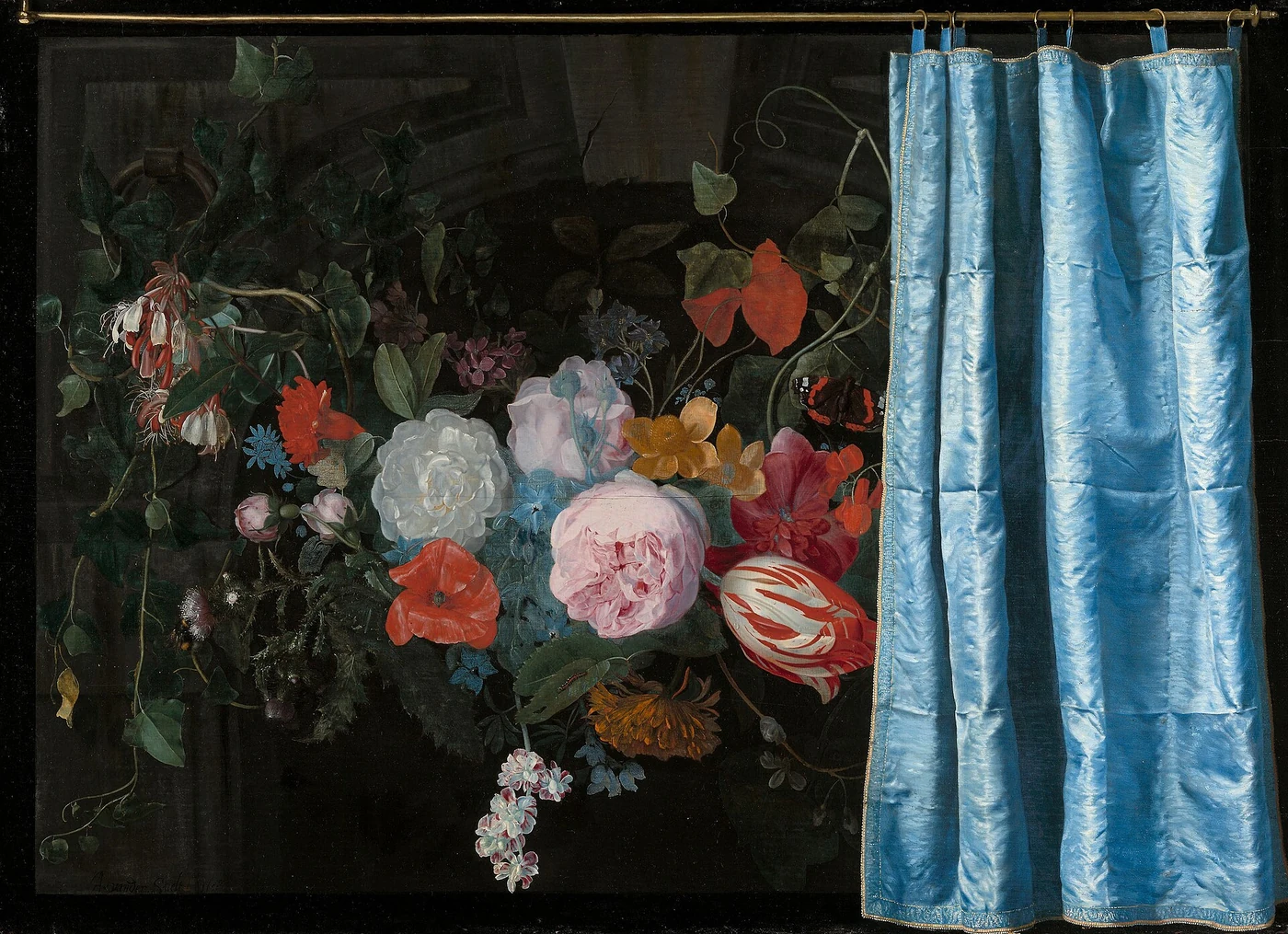
Trompe-l’Oeil Still Life with a Flower Garland and a Curtain, Adriaen van der Spelt and Frans van Mieris, 1658. Art Institute of Chicago; Wirt D. Walker Fund. Public-domain artwork.
- What is trompe-l’œil? Realistic isn’t always deceptive
- The blue curtain: a cover becomes part of the trick
- The back of a painting that isn’t the back
- The Old Violin: convincing doesn’t have to mean shiny
- Three clues to depth: what should you look for?
- Try it: draw a piece of paper that seems to lift
- Why is the trick still fun after you know it?
- Images and sources: actual paintings, not recreations
Look at the cover. There is a garland of flowers and a blue curtain that seems to have been pulled aside. Forget whether the flowers are beautiful for a moment. Ask a stranger question: is that curtain inside the picture, or hanging in front of it?
Reach for it and you would find no fabric. The curtain is painted too. That is the pleasure of trompe-l’œil: you know you are looking at a flat surface, yet something in the image briefly seems to step out of it.
No memorising long artist names required. We will look at three real paintings, follow the details that make their tricks work, then try a small pencil exercise. You do not need exceptional drawing skills to begin—just a little patience, a piece of paper and somewhere with good light.
What is trompe-l’œil? Realistic isn’t always deceptive
The French term trompe-l’œil means “deceive the eye”. The Metropolitan Museum of Art’s guide explains the tradition of painting objects that appear physically present, rather than simply represented within a picture.
Here is a useful distinction. A beautifully painted apple says: “This is a picture of an apple.” A painted note that seems pinned to the canvas, casting its own shadow, asks: “Did the artist attach an actual piece of paper here?” If the paper really is pasted on, that is a real material in the artwork, not a paper illusion made with paint.
You do not have to be fooled for a painting to be enjoyable. Spotting the trick can be the beginning of the experience, not the end. Think of watching a magician: knowing the rabbit did not materialise from nothing hardly makes you less curious about the hat.
The blue curtain: a cover becomes part of the trick
The cover painting dates from 1658. Adriaen van der Spelt painted the flowers; Frans van Mieris painted the curtain. The Art Institute of Chicago connects the curtain to the practice of protecting paintings with covers.
Look twice. First, follow the flowers. Then ignore them and study the blue folds. Which edge seems closest? Where does the fabric disappear into darkness? Let your gaze travel between the bright and shaded areas rather than hunting for a single correct answer.
What makes the idea playful is that something you might expect outside a painting has moved inside it. The curtain suggests an action: “Pull this and you could see more.” But there is nothing waiting behind it. That little movement happens in your imagination.
The back of a painting that isn’t the back
Your first reaction might be: “You uploaded the wrong side.” That is the joke. This work in SMK, Denmark’s national gallery, depicts a painting’s reverse, but you are looking at its painted front.
Pick one small detail instead of scanning the whole rectangle. Try the paper label near the upper left: trace its edge and the shadow beside it. Then move to the frame. Where does the imagined wood stop and the imagined canvas begin? Both are paint, yet they suggest different materials.
No hero is running across the scene. No dramatic landscape fills the horizon. The story is your expectation. You came looking for the picture, and the picture replies: “I am here—you were just looking for something else.” It is a quiet visual joke that does not need a lecture to land.
The Old Violin: convincing doesn’t have to mean shiny
Harnett made this painting in oil on canvas. The National Gallery of Art reports that a police guard was needed to keep disbelieving viewers from getting too close when it was exhibited. That is not an invitation to touch museum paintings; your eyes can do the exploring.
Start with the envelope at the lower left, not the violin. If you could pull it out, which edge would you hold? Then look for something that seems neglected or imperfect. Does that detail make the objects feel as though they have lived a life outside the image?
It is a useful question for anyone who draws or takes photographs. Sometimes a small trace matters more than the grand subject. A picture need not present immaculate surfaces to be attractive; what draws you in may be a suggestion of use, time or an absent owner.
Three clues to depth: what should you look for?
The Getty’s guide to analysing art describes how perspective and shading suggest depth on a flat surface. You can begin without learning a dictionary of terms. Use these questions:
- Overlap: which object hides part of another? Follow the edges instead of taking in the entire subject at once.
- Light and shadow: can you tell where the light comes from? Which areas darken? Does a shadow seem attached to an object or separated from it?
- Viewpoint: are you seeing only a front face, or a side as well? What changes when you raise the image or look from beside the screen?
These are looking prompts, not an intelligence test or a promise that everybody will see the same thing. Screen size, surrounding light and how a work is displayed can strengthen or weaken the effect. A small phone reproduction is not the same experience as standing before the original.
Try it: draw a piece of paper that seems to lift
Keep the goal modest: this is an exercise in noticing shadows, not a guaranteed recipe for museum-worthy illusion. Gather drawing paper, a pencil, an eraser and a small paper scrap with one corner gently bent upward.
- Place the scrap on a table beside your drawing sheet. Use one main light source—a window or lamp is enough. Do not shine a powerful light into your eyes.
- Lightly sketch its outline, including the raised corner. Leave the tiny details until later.
- Find the shape of the scrap’s shadow before shading it. Avoid adding a black halo around every edge just because you want the object to stand out.
- Add light pencil tones to the folded area as you see it, keeping the illuminated area cleaner. Erase heavy outlines that make the paper look framed.
- Step back and compare the drawing with the scrap. Change one thing—the shadow shape or the darkness of the fold—not everything at once.
If the illusion falls flat, resist adding twenty new details. First ask whether the shadow is in the right place and whether the drawn corner resembles the one in front of you. Discovering the difference is part of the fun. You are learning to look, not simply to fill a page.
Why is the trick still fun after you know it?
Because the pleasure is not just making a mistake. It is switching between two thoughts: “That is only paint” and “But look how it appears.” Knowing the explanation need not diminish the curtain any more than knowing the ending stops you enjoying a favourite song.
And if realistic painting is not your taste, that is fine. Trompe-l’œil is one approach to art, not a scorecard for every artwork. A picture that never tries to deceive you may mean more to you than one you almost reach out to touch.
On your next museum visit—or while browsing artworks online—give one image an extra half-minute. Choose a small detail and ask: “How did this make me believe it?” A blue curtain can be a surprisingly enjoyable place to start a conversation with art.
Images and sources: actual paintings, not recreations
All three artwork images are identified as public domain by the collections credited here. The cover reproduces the Art Institute of Chicago’s painting via Wikimedia Commons. SMK and National Gallery of Art links accompany the other images. Historical information comes from the museum records linked in the text. The viewing questions and pencil exercise are practical suggestions for this article, not a scientific test or a claim of specialist training.
All three images show real artworks, not AI-generated substitutes. Web copies were resized and compressed without changing the paintings. Artwork credits and museum links appear in the article; use does not imply museum endorsement of Dajran.