Why Does the Moon Look So Big Near the Horizon? Try This Simple Test
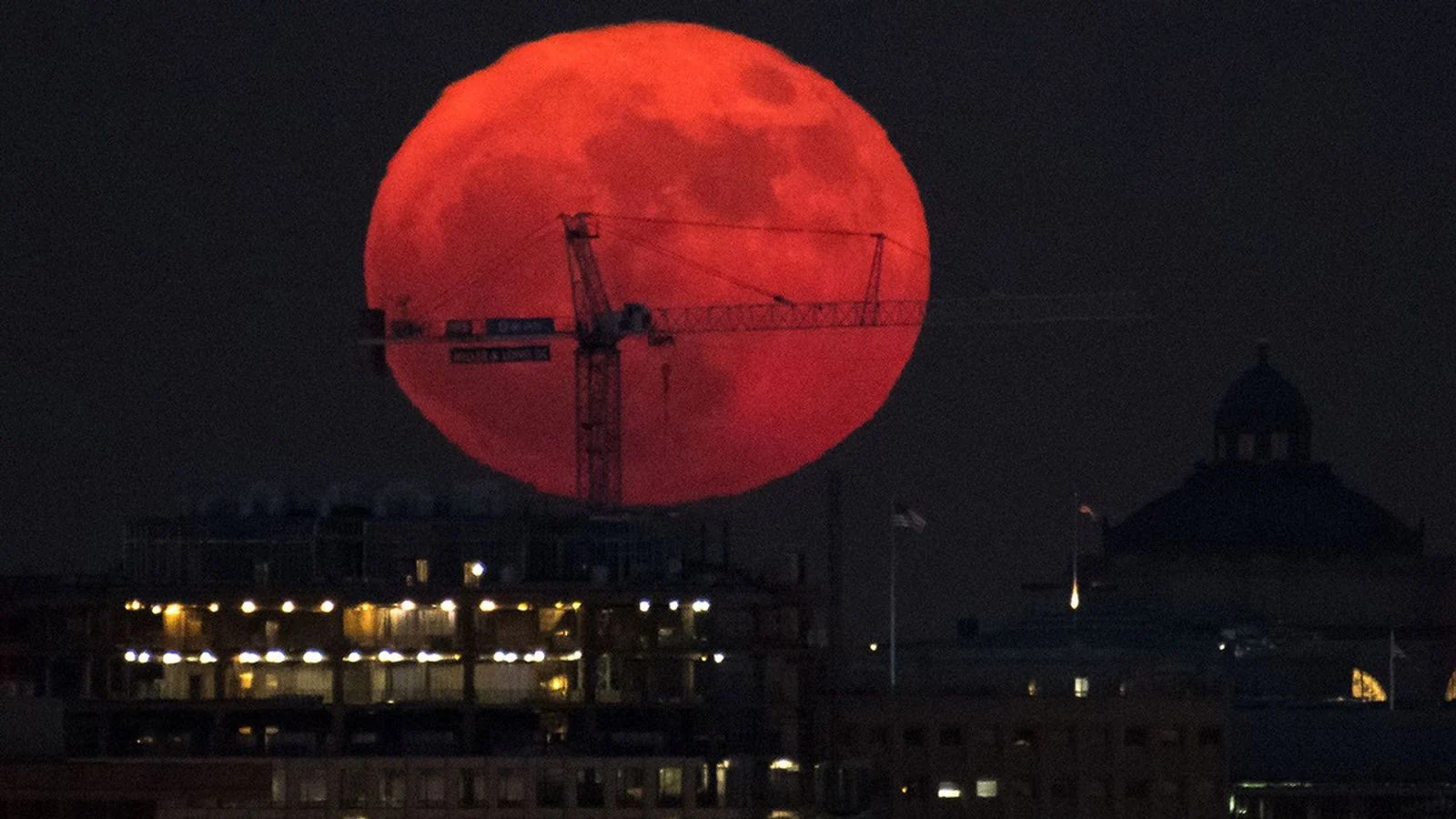
A supermoon rising over Washington on 3 December 2017. Photo: NASA/Bill Ingalls; a photograph, not a measure of its perceived naked-eye size.
- First: the Moon is not inflating as it rises
- Is the atmosphere a magnifying glass? Not in that sense
- What is your brain doing? This is where the story gets interesting
- Try the comparison: two photographs under similar conditions
- Why are “giant Moon” photographs so spectacular?
- A supermoon is not the same as the Moon illusion
- The daytime Moon: the photograph is not mistimed
- Make it a small curiosity game with a friend
- What should you take into the next Moon watch?
The Moon emerges from behind the buildings, and you stop: was it this big yesterday? You reach for your phone, take a picture, and open it. The enormous Moon has become a small disc. Your camera is not necessarily bad, and the Moon has not shrunk between the glance and the photograph. You have met a beautiful mismatch between seeing and measuring.
It is called the Moon illusion: the Moon can look much larger near the horizon than high in the sky, although its angular width stays very similar over the same night. Understanding it does not require memorising equations. You can turn the view into a small observation—and come back to it with a better question.
First: the Moon is not inflating as it rises
There is a difference between physical size, the space the Moon's image occupies in your field of view, and the size you feel it looks. The illusion concerns the last of these. This Moon-illusion explainer describes how photographs taken with the same settings can separate an impression from a measurement.
Think of the difference between “that looked magnificent” and “the disc actually became wider.” The first describes a genuine experience; the second needs a comparison. You do not have to accuse your eyes of lying. Give them a partner: a small measurement rather than an impression alone.
Is the atmosphere a magnifying glass? Not in that sense
The atmosphere affects the Moon's shape and colour near the horizon, but it does not account for the enormous expansion we feel we see. A scientific explanation published in February 2025 notes that refraction can squash the image vertically a little, rather than magnify it like a giant lens.
The yellow or orange colour can deepen because moonlight travels through more atmosphere and some wavelengths scatter more than others. The colour can really change while the impression of enormous size is a different perceptual question. “Why is it orange?” is not the same question as “Why does it look so big?”
What is your brain doing? This is where the story gets interesting
No single agreed explanation settles every detail of the Moon illusion. Proposed ideas connect size perception with distance and surrounding context: buildings, trees and lines stretching towards a horizon. But “your brain compares it with the trees” does not solve the whole puzzle. The scientific explanation linked above presents a popular idea as a hypothesis, not a final answer.
Picture a distant bus: you expect its image to become smaller as it moves away. We are used to such everyday distance cues; the Moon confronts us with a different scene. That is a way to approach an explanatory idea, not proof of exactly what happens inside your brain each time. You can understand the question even when science has not closed it completely.
Try the comparison: two photographs under similar conditions
Choose a clear night when the Moon is visible, preferably around full Moon for a distinct disc. The article does not assume a full Moon is happening tonight. The idea follows this photographic comparison guide; here is a simple way to organise your observation:
- Write your impression first: does the Moon look enormous or ordinary? Choose a description, not a number you have not measured.
- Photograph it low: stay in a safe location, get the Moon as clear as you can, and keep the original file.
- Photograph it again higher up: on the same night, use the same camera, lens and zoom. Do not switch from 1× to 3×; watch for a phone automatically changing lenses.
- Compare horizontal width: view both files at the same scale, without cropping or enlarging one differently. Compare left-to-right diameter, not only height.
- Record what happened: was the change in your impression larger than the difference in the images? Keep the question even if the photographs are imperfect.
Expect similar widths, not guaranteed laboratory precision from every phone. Shake, focus and automatic processing can complicate the comparison, and the low Moon can look slightly compressed vertically. If it is only a blurry dot, do not extract a precise conclusion. A camera with a suitable long lens can give a clearer measurement than many phones.
Observe safely: this activity is for the Moon, not the Sun. Never direct your eyes or optical equipment towards the Sun. Do not step into a road or lean out of a balcony for a better angle. A safe place matters more than a photograph.
Why are “giant Moon” photographs so spectacular?
A picture showing a huge lunar disc beside a distant crane or building does not necessarily represent what your phone would capture from that location. The Moon-illusion explainer discusses long lenses and zoomed views of distant foreground features. A stunning picture is not automatically a fake; nor does the Moon's size inside its frame measure how large it felt to your unaided eyes.
Ask a few curious questions: what lens was used? Was a distant landmark chosen to share the frame? Is it one photograph or a disclosed composite? This is not a trial of the photographer. It lets you enjoy the picture while understanding how its effect was made.
A supermoon is not the same as the Moon illusion
The supermoon explainer describes an orbit that is not a perfect circle, so the Moon's distance changes during its cycle. The term is used when a full Moon comes near its closest orbital approach. That produces a real difference in apparent size due to distance, unlike the perceived expansion at the horizon.
A full Moon near its closest approach can appear about 14% larger than one near its farthest—not than every ordinary full Moon. That is a specific comparison between the ends of the distance range, not a promise of a double-sized disc over your house. A supermoon can also look larger at the horizon because of the illusion. The effects are not alternatives to one another.
The daytime Moon: the photograph is not mistimed
The daytime Moon is not a fault in the scene. Its position relative to Earth and the Sun changes through the month, and seeing it is not limited to night. This Moon-phases guide explains that geometry. Do not turn two unrelated lunar photographs into a supposedly controlled comparison: phase, lens and conditions may differ.
Make it a small curiosity game with a friend
Before showing the files, ask a friend watching with you: “Do you expect the Moon's width to be greater in the first picture?” Record both predictions, then open the originals. Nobody needs to win. The interesting part is discovering the gap between a strong impression and a fair comparison.
For another attempt, keep three notes: the time, the lens or zoom, and whether clouds or haze were present. This is not a Dajran field study, and your home observation is not a research measurement. It is an enjoyable starting point for learning to ask a question and choose a comparison that suits it.
What should you take into the next Moon watch?
- A large-looking Moon near the horizon has not necessarily expanded.
- Colour, atmospheric refraction and the size illusion are related questions, not the same thing.
- A useful comparison needs similar settings and viewing scale—not two random internet photos.
- There are explanations under investigation, but one hypothesis should not be sold as the final solution.
Next time, give the view a moment before opening your camera. Then, if you want, start comparing. Knowing something about a picture need not make it less beautiful. It may add a question worth sharing with the person beside you.
An editorial explainer based on the linked scientific sources, not a report of a field experiment we conducted. Real photographs retain their credits; NASA has not reviewed or endorsed this article. Sources checked on 12 October 2026.
Two real photographs from the linked source: cover NASA/Bill Ingalls; inline image NASA/Bill Dunford. They are not a controlled comparison; the Moon was not resized within either image.