Why Your Cat Scratches the Sofa—and How to Save It Without Punishment
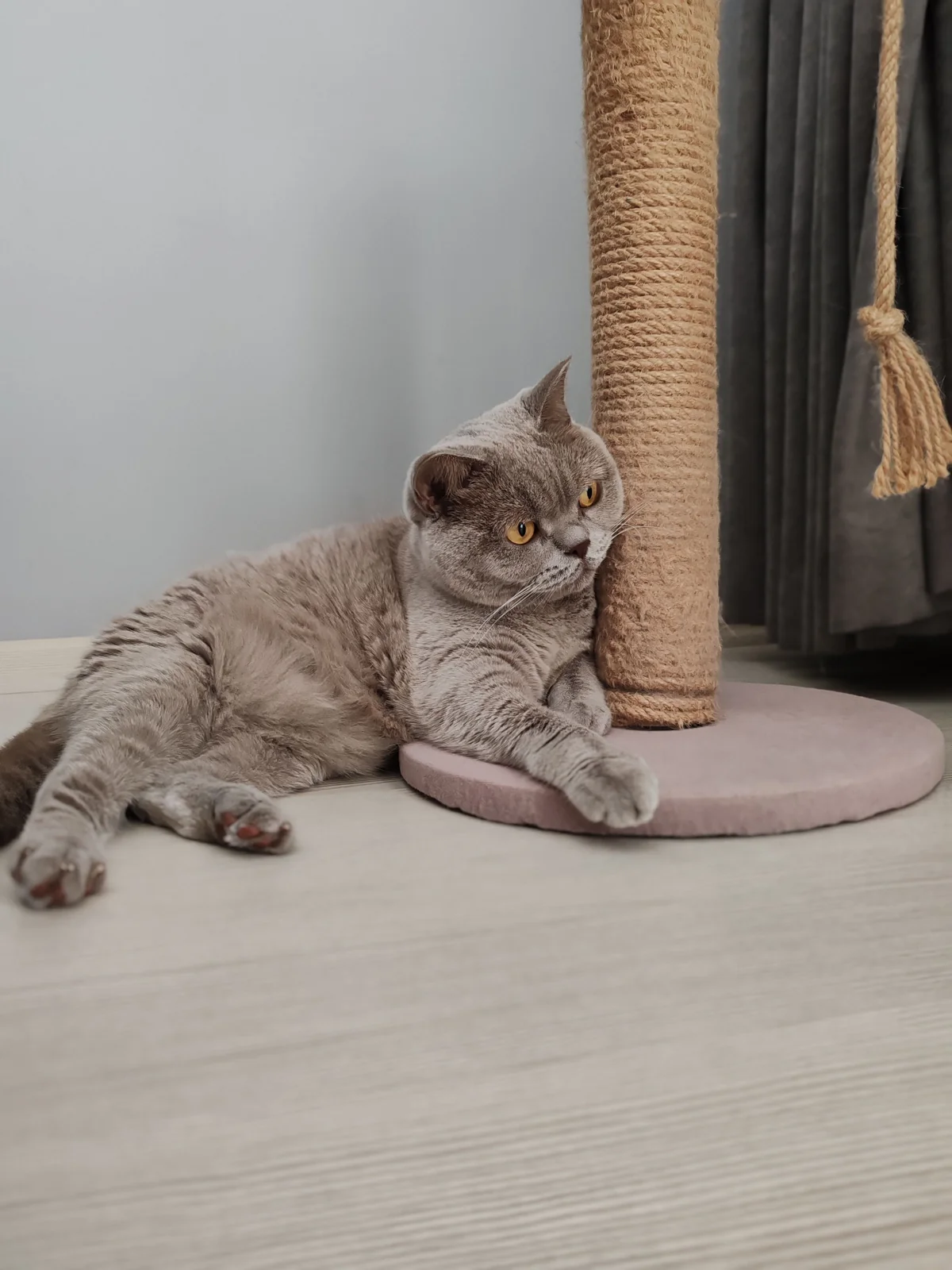
A grey cat resting beside a scratching post. Photo: [A] [B] [S] / Pexels; illustrative, not a Dajran training result.
- Your sofa is not the victim of a revenge plot
- Before shopping, read three clues in the room
- Choose a competitor for the sofa, not a decorative ornament
- Location matters: start where the marks are
- Reward the right moment, not the entire performance
- Protect the furniture without frightening the cat
- A tiny log keeps you from changing everything at random
- When you need help, not another scratching post
- Quick questions before the first attempt
You bought a scratching post. Your cat thanked you by sitting beside it, then returned to the sofa arm. To you, that is damage to a favourite piece of furniture. To your cat, the new option may simply be less appealing than the old one. The useful question is not how to win an argument—it is how to understand the choice.
The aim is to redirect scratching, not eliminate it. Observe the preferred surface, offer a stable alternative nearby, and reward its use. This is a general planning guide, not a veterinary diagnosis or a promise that every cat will change within a fixed number of days.
Your sofa is not the victim of a revenge plot
The Cornell Feline Health Center explains that scratching is normal behaviour: it leaves scent and visible marks and removes the outer claw sheath. Revenge is not the usual explanation.
VCA's veterinarian-authored scratching guide also describes the stretching involved. “How can I stop all scratching?” is therefore a different task from “Where can my cat do it safely?” An invisible sign reading SOFA OFF LIMITS cannot replace an outlet for the behaviour.
Before shopping, read three clues in the room
Make your first round an observation round, not a shopping trip. Cornell recommends noting the preferred material and direction. Write down three things:
- Direction: does your cat reach up the sofa arm or work on the rug below it?
- Surface: where are the marks concentrated—textured fabric, wood, or one particular mat?
- Location: is the alternative beside that spot or behind a door your cat rarely passes?
A hypothetical example: a smart-looking post in a spare room, with fresh marks on the living-room sofa. Before calling the cat stubborn, write “the alternative is far from the chosen spot.” That observation suggests something you can review. A personality label does not.
Choose a competitor for the sofa, not a decorative ornament
Cats Protection's scratching advice recommends a stable base and enough height for a vertical scratcher to stretch fully. A cat choosing horizontal surfaces may prefer a scratching pad instead. There is no universal perfect size.
Check stability by hand before offering it. If it tips or slides, follow the product instructions to address that; do not rely on wedging it between furniture that could fall. In a small apartment, ask what the item does before considering its size: does it offer an accessible, suitable surface, or merely fill a corner?
Location matters: start where the marks are
VCA's furniture-scratching guide recommends positioning the alternative at the chosen area, then moving it gradually once it is being used. Do not begin by hiding it in your preferred tidy corner.
Think of replacing a parking space rather than penalising a driver: the new option needs to be obvious and nearby. Do not block a walkway or access to food, water or the litter tray. With several cats, review the distribution of resources rather than making them all share one spot. The FelineVMA indoor-cat statement emphasises separated, accessible resources.
Reward the right moment, not the entire performance
The FelineVMA positive-reinforcement statement recommends a reward the individual cat values, delivered immediately after the desired action. Reward the scratcher's use, rather than waiting until the cat has walked away and started doing something else.
Have the reward ready before observing. It need not always be food; a cat may prefer play or gentle social contact. If you use food, account for it within an appropriate diet and check with your vet when dietary restrictions apply. Do not carry the cat over and drag its paws down the post to force a demonstration.
The positive-training guidance notes different learning speeds and preferences, and advises against training a frightened, sick or painful cat. If your cat withdraws, do not turn the moment into a chase. Return to observing.
Protect the furniture without frightening the cat
Choose an appropriate commercial furniture protector, installed as instructed, while providing an alternative. FelineVMA's unwanted-behaviour guidance recommends furniture protection and a sturdy post at the location, and opposes punishment such as water spraying. It also opposes declawing because of potential pain and behavioural changes; surgery is not a replacement for a suitable environment.
Do not turn home protection into a trap-building project: no dangling strings, electric shocks or sudden-noise tricks. Inspect damaged or detachable parts. Keeping the sofa intact is not worth making the living room frightening for the animal sharing it with you.
A tiny log keeps you from changing everything at random
Copy this into your phone notes if it helps. It is our suggested household organiser, not a scientific test or a validated treatment schedule:
- Where I found the marks: ______
- Direction and material: ______
- The one change I will try: ______
- What I saw: used the alternative / ignored it / avoided it / did not observe an attempt.
- Next question: location, stability, or direction?
Another hypothetical example: you moved the post from the hallway to the sofa and saw one use. Write “used once,” not “problem solved.” A small, honest observation is more useful than declaring victory, then ordering three unrelated posts when another mark appears.
Review your notes at the end of the week if you like. A week is an organising interval here, not a deadline every cat must meet. Change one thing so you can follow what happened, and do not delay veterinary advice to finish the log.
When you need help, not another scratching post
Seek veterinary advice for a sudden change or persistent concerning behaviour rather than assuming bad manners. Cats Protection's behaviour-management guide stresses ruling out medical causes; suitable behavioural support may also be needed. Marks on furniture alone cannot tell you whether the issue is surface preference, distress or a health concern.
For communication cues, see our cat body-language guide. For a wider environmental review, try indoor-cat enrichment on a budget. These are complementary topics, not diagnoses of your cat.
Quick questions before the first attempt
My cat ignored a post. Should I buy a more expensive one? Review direction, stability and location first. Price does not tell you whether it matches the preference you observed.
Does nail trimming remove the need to scratch? No. Ask your vet or a qualified professional to explain safe claw care, especially if you have not learned it; this article is not a trimming tutorial.
What can I do today? Photograph the furniture marks, note the position and direction, and inspect the existing alternative. Perhaps the sofa is not winning because your cat is against you. Perhaps it is simply the better offer so far.
General editorial guidance based on the linked references, not an individual veterinary review or a training trial conducted by Dajran. Sources checked on 13 October 2026. Cover photograph: [A] [B] [S] / Pexels; both photographs used under the Pexels licence.
Two real Pexels photographs are credited and linked in the article. They were resized and converted to WebP without changing the scene; their use does not imply endorsement by the photographers or cited organisations.