That Isn’t Snow: Inside Pamukkale’s Turquoise Cotton Castle
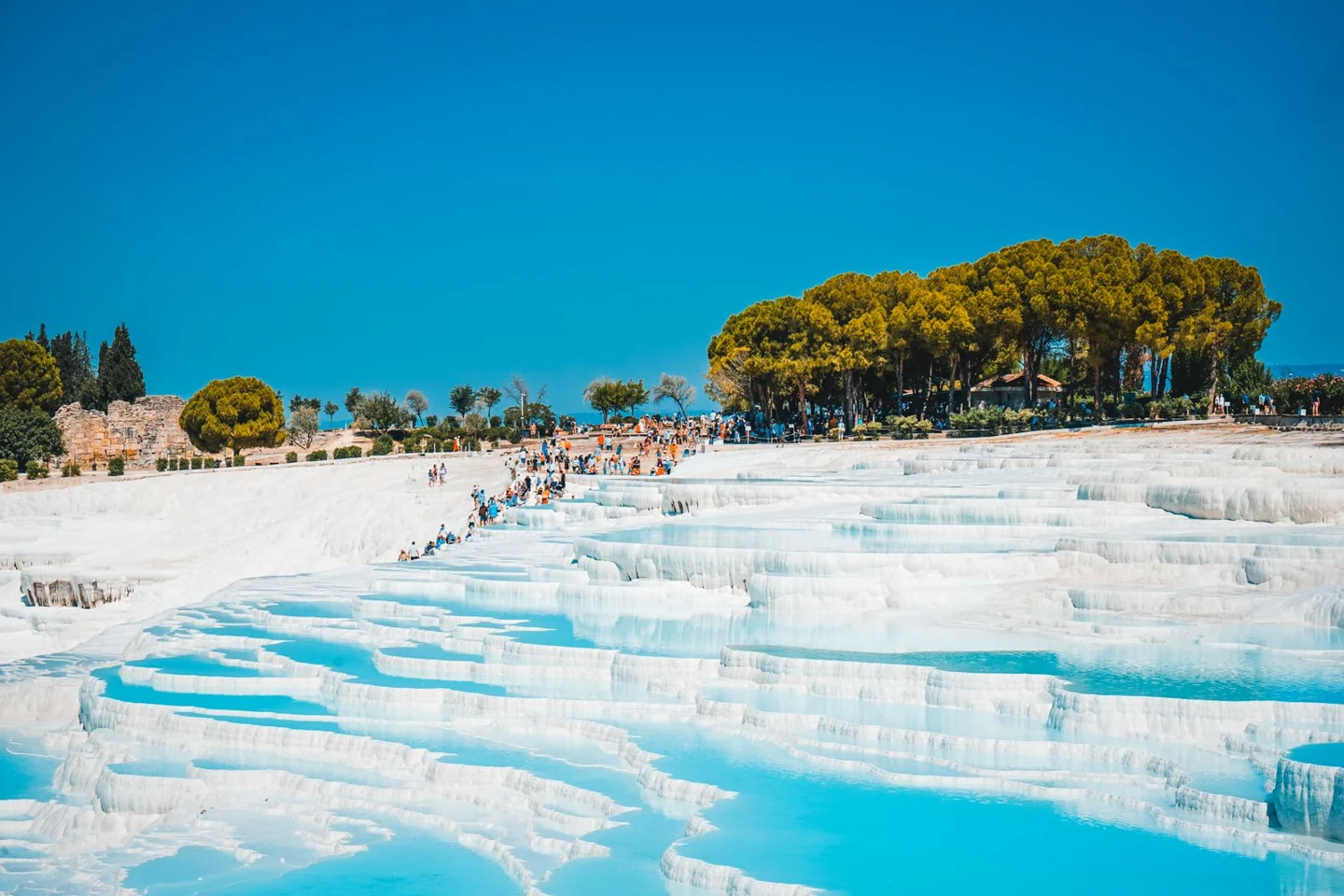
White travertine terraces and turquoise pools at Pamukkale, Türkiye. Photo: Ne Hayaldesin / Pexels; a real photograph, not a promise that every basin will be full during a visit.
It looks as though someone tipped a tray of turquoise paint over a snowy hillside. But the white terraces in this photograph are not snow, and the scene is not an AI fantasy. This is Pamukkale, Türkiye: a place where water has been quietly building its own staircase.
The photograph makes you stop. The better question is what happens after that first “wow”: what are you actually looking at, and how can you enjoy it without expecting an enormous outdoor swimming pool?
First, the surprise: the white stuff is stone
Pamukkale’s terraces are travertine, a rock formed by mineral deposits from flowing thermal water. The name means “cotton castle.” According to UNESCO’s site description, calcium-rich springs have created stepped basins and formations resembling frozen waterfalls. That combination of white edges and blue water is the attraction—not a winter snowfall.
Look closely at the photograph rather than treating it as one big blue patch. Water gathers behind thin rims, then the next terrace begins. Seeing those repeated edges is more satisfying than simply collecting another location for a bucket list.
Why a beautiful photograph is not a promise
A picture freezes one angle, one light condition and one moment of water distribution. It does not guarantee that every basin will be full on your visit. GoTürkiye explains that flowing mineral water continues to shape the terraces and that protecting its direction matters. Think of the landscape as a working natural system, not a swimming-pool display kept identical for each visitor.
Before booking, ask a practical question: would I still enjoy this place if my favourite pool in the photograph were dry? If the answer is yes because you love landscapes and ruins, you are choosing an experience. If not, you may be buying a photograph that cannot be promised.
There is an ancient city above the postcard
The combined World Heritage property includes Hierapolis as well as the terraces. UNESCO highlights the relationship between the natural landscape and the archaeological remains. The official route suggestions include the ancient theatre, museum and northern necropolis.
Our suggestion is to plan two chapters rather than one photo stop: first the landscape, then the ruins. You do not need to turn the day into an endurance challenge. Choose the stops you genuinely care about and leave space to sit, look and change your mind.
Three photographs worth taking with your phone
- The wide scene: include a line of terraces leading across the frame. Keep the horizon straight and avoid filling most of the photograph with empty sky.
- The texture: photograph a rim and a small patch of water from an authorised viewing position. You do not need to step into a protected area for a closer composition.
- The second story: make one frame about the ruins rather than water. It will help you remember the place, not just its most repeated online angle.
On bright surfaces, check the preview and reduce exposure a little if the white has lost all detail. This is a starting point, not a fixed camera setting: the right result depends on the light and your phone. Keep a natural-looking edit instead of forcing every pool into electric blue.
Visit the permitted route, not the photograph’s route
Do not assume every terrace visible online is open for walking. UNESCO describes access restrictions for conservation, while GoTürkiye discusses barefoot walking on visitor-accessible terraces. Follow current signs and staff directions: an authorised path is not permission to wander across the whole formation.
- Check current opening hours, entry arrangements and any separate attraction charges with the official operator before leaving.
- Ask about steps, uneven surfaces and access needs before committing to a route.
- Carry water and sun protection, and leave yourself time instead of rushing for one photo.
- Never scrape the stone, remove deposits or cross barriers for a cleaner background.
Is it worth adding to your trip?
Consider it if you enjoy the meeting point between an unusual landscape and an ancient city. Reconsider a rushed detour if all you want is guaranteed swimming or a crowd-free copy of somebody else’s photograph. No article can promise either.
For a wider trip, start with a realistic short-trip budget before adding another stop. Pamukkale’s best souvenir need not be the most dramatic picture. It can be the moment you realise that the “snow” in front of you was made by water leaving something behind.
Sources and image credits
Natural and heritage context: UNESCO, linked above. Formation and visitor context: GoTürkiye, linked above. This is a researched feature, not a Dajran on-site visit. Access and prices can change; no current ticket price is promised.
Cover: Ne Hayaldesin / Pexels. Interior photograph: Abdullah BEGTAŞ, linked in its caption. Both are used under the Pexels licence.
Both photographs are from Pexels, credited and linked above. They were resized and converted to WebP with the full scene preserved; no elements were generated or added.