The Red Planet Has Blue Sunsets? These Real Mars Photos Explain Why
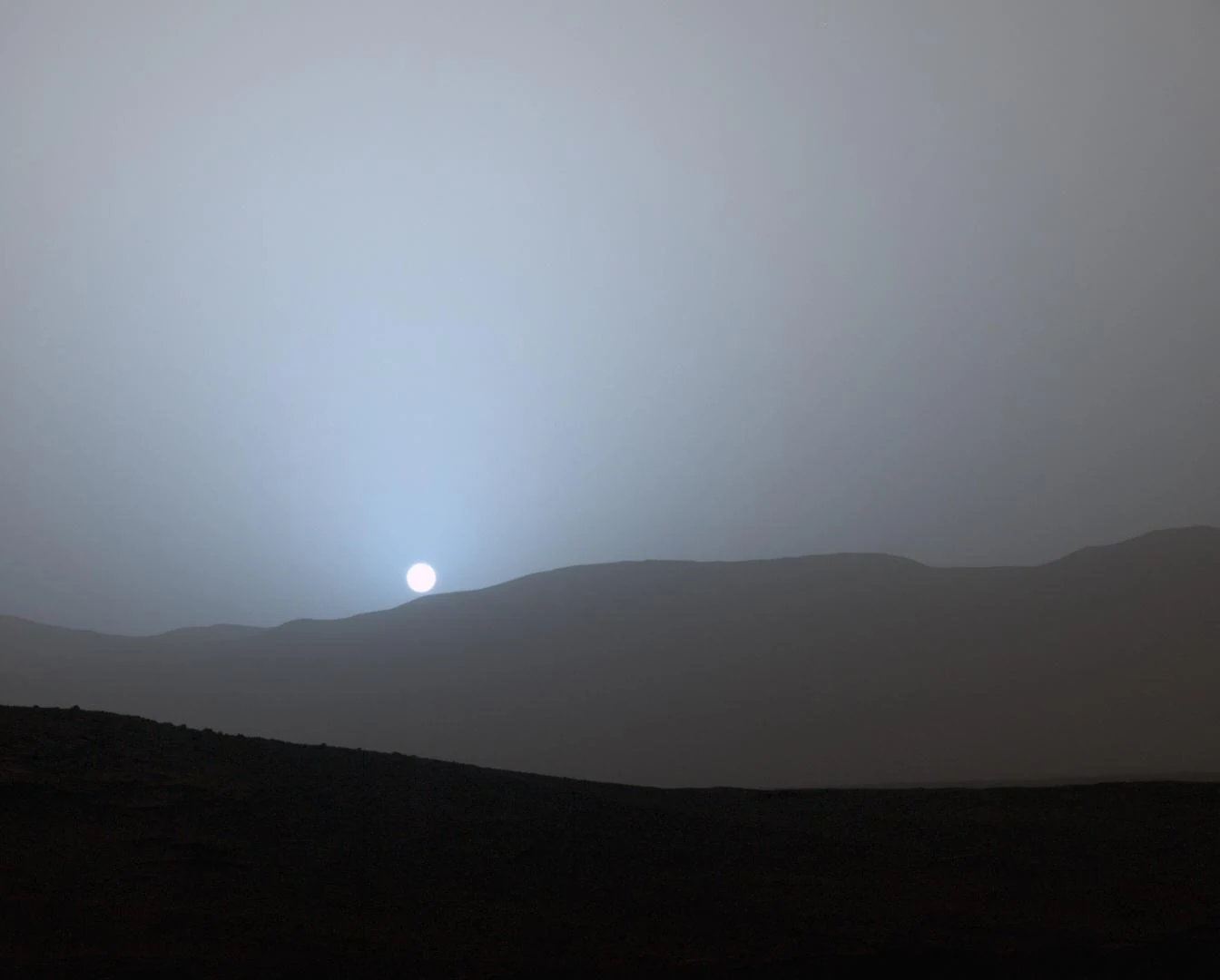
Sunset recorded by Curiosity in Gale Crater on 15 April 2015; a colour-calibrated observation, not an AI illustration. NASA/JPL-Caltech/MSSS/Texas A&M Univ.
- The short answer: dust changes the light’s journey
- Why is our sunset usually warm-coloured?
- Real photograph does not mean untouched camera output
- Another robot saw the same kind of surprise
- Why every Martian sunset need not look identical
- Try reading the picture before reading the explanation
- What makes this more than a pretty postcard?
- Sources and image credits
We call Mars the Red Planet. Then a robot sends home a sunset with a blue glow around the Sun. Has somebody moved the colour slider? Not in the way that question suggests: the scene is real, and the explanation is hiding in the dust.
The cover is a photograph recorded by NASA’s Curiosity rover on 15 April 2015. It is an older observation, not a newly announced discovery. That hardly makes the view less surprising: the same Sun we watch from Earth is putting on a different ending to the day.
The short answer: dust changes the light’s journey
Sunlight contains a range of colours. A planet’s atmosphere changes how those colours reach an observer. In JPL’s explanation of this photograph, fine Martian dust allows blue light to remain more concentrated near the Sun’s direction, while red and yellow light scatter more widely. The effect becomes especially noticeable along the longer atmospheric path near sunset.
So the useful headline is not “Mars has turned blue.” It is “the sky close to the setting Sun can look blue.” That small difference keeps a lovely fact from becoming a misleading one.
Why is our sunset usually warm-coloured?
On Earth, air molecules scatter shorter blue wavelengths strongly. When the Sun is low, its light crosses a longer path through the atmosphere, and much of that blue is scattered out of the direct view, leaving warmer colours more prominent. NASA Space Place explains this contrast for readers without a physics background.
Think of sunlight as a mixed crowd and the atmosphere as the route everyone must take. Change the route and what is along it, and a different group reaches the same viewpoint. It is an analogy, not a literal colour-sorting machine, but it gets you past the idea that the Sun itself changes colour to match each planet.
Real photograph does not mean untouched camera output
JPL identifies this view as Curiosity’s first sunset observed in colour. Its Mastcam image was calibrated and white-balanced to remove camera artefacts. Those processing steps are disclosed in the original record; they are not evidence that the blue glow was painted into an invented scene.
Equally, “NASA image” is not a promise that every space photograph uses the same colour treatment. Read the caption. A natural-colour approximation, an enhanced-colour image and an artist’s illustration answer different questions. Sharing them with the same vague label loses useful information.
Another robot saw the same kind of surprise
NASA’s Pathfinder image record attributes the blue near the Sun to dust rather than water-ice clouds. Putting the two views together is more useful than treating one beautiful frame as the whole story: they come from different missions and observations, yet show a comparable colour contrast.
Why every Martian sunset need not look identical
In its gallery of Martian sunrises and sunsets, NASA includes a 2021 Perseverance view with a more muted colour, associated with less atmospheric dust. Blue is a characteristic effect, not a guarantee of an electric-blue sky in every direction, every evening.
That is a good habit for reading any dramatic science picture: ask which conditions produced it before turning it into a universal rule. “Can look like this” is often more accurate—and more interesting—than “always looks like this.”
Try reading the picture before reading the explanation
- Find the brightest part of the sky and notice how close the blue sits to it.
- Compare that area with the sky farther away. Is it the same shade?
- Read the mission, observation date and colour-processing note.
- Only then decide what claim the photograph actually supports.
You can practise noticing changing colours in your own evening sky without looking directly at the Sun. Never stare at the Sun or use binoculars, a telescope or an optical viewfinder to examine it without appropriate specialist protection.
What makes this more than a pretty postcard?
NASA explains that twilight observations help scientists study dust and clouds. Beauty and measurement are not opposites: a frame can stop us scrolling and still contain clues about an atmosphere.
If you enjoyed having your expectations overturned, try the Moon illusion near the horizon next. The best part of this sunset is not that another planet is strange. It is that familiar sunlight becomes strange when you finally pay attention to the air—or dust—between it and your eyes.
Sources and image credits
Primary sources: JPL’s Curiosity photograph, NASA Space Place, NASA’s Pathfinder record and NASA’s sunset gallery, linked beside the relevant explanations. Cover credit: NASA/JPL-Caltech/MSSS/Texas A&M Univ.; interior: NASA/JPL. See NASA’s image-use guidelines. No NASA endorsement is implied.
Both images are real observations published by NASA, with colour processing described in the original records. Our preparation was limited to resizing and WebP conversion; no colours or scene elements were added.