Axolotls Can Regrow Limbs—but They’re Losing Their Wild Home
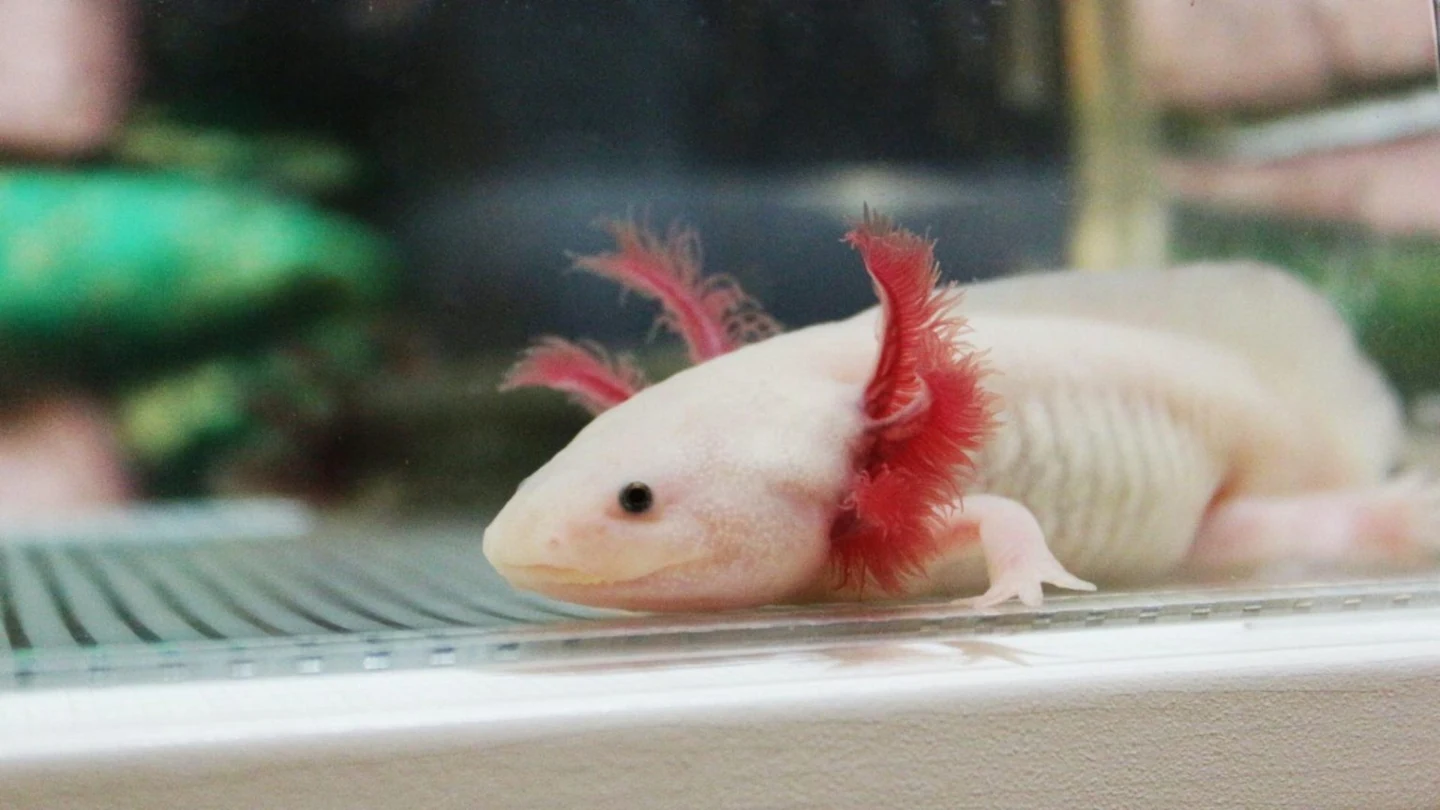
A pale axolotl with external gills in a tank. Photo: Hannah Kao / WordPress Photo Directory, CC0; not a photograph of an animal in its wild habitat.
- First surprise: it is not a fish
- How can it be an adult and still look like a baby?
- That little smile is not a mood report
- Regrowing a leg means rebuilding, not sticking it back on
- Why the pink celebrity is not the whole species
- The problem a new leg cannot solve
- A three-question quiz for your next conversation
- One more look at the “smile”
- Sources and photographs
The axolotl looks like somebody gave a tiny underwater dragon a permanent half-smile and a pair of extravagant feather earrings. It is real. So is its remarkable ability to regrow a lost limb. The part that sounds least believable is this: an animal so famous in aquariums and online is critically endangered in the wild.
That contrast makes the axolotl worth more than a quick “cute!” Its body tells one fascinating story. Its shrinking home tells another. Start with the face, but stay for what is behind it.
First surprise: it is not a fish
Despite the nickname “Mexican walking fish,” the axolotl is a salamander—an amphibian. Its scientific name is Ambystoma mexicanum. Look past the underwater setting and you can spot little limbs, toes and a broad head rather than a fish’s familiar shape.
The American Museum of Natural History explains its unusual life cycle: it keeps features associated with the young stages of other salamanders, including external gills and a fin. The fringes beside its head are working equipment, not decorative hair.
How can it be an adult and still look like a baby?
Many amphibians undergo a dramatic transformation as they develop. The axolotl normally reaches adulthood while retaining juvenile physical traits, a pattern called neoteny. This does not mean it is an eternal baby or incapable of reproducing; it means development does not follow the familiar tadpole-to-frog script.
San Diego Zoo’s animal profile describes its aquatic life, prominent gills and functional lungs. A creature can be an amphibian without spending its adult days strolling around on dry land. Nature has more than one version of growing up.
That little smile is not a mood report
A curved mouth and wide-set eyes make a wonderfully expressive photograph. But a photograph cannot tell us that an animal is delighted, enjoying attention or asking to be picked up. “Smiling” is a description of how the face looks to us, not a measurement of its welfare.
Try a small exercise: look at the cover without its headline. What can you actually see? Gills, eyes, skin colour, the position of the feet. What have you added? A personality, perhaps, or a conversation. Enjoy the character without confusing your caption with evidence. It is the same habit that helps us understand a cat’s body language rather than guessing from one cute pose.
Regrowing a leg means rebuilding, not sticking it back on
The Marine Biological Laboratory studies how axolotls regenerate complex tissues. Regrowing a functional limb involves more than closing a wound: tissues must be rebuilt in a coordinated way. Researchers investigate the cellular signals and processes behind that response.
The important distinction is between a discovery in an animal and a treatment ready for people. Axolotl research is not a promise that humans can already regrow a missing arm. It is a way to ask better questions about how bodies repair themselves. And regeneration is never a reason to injure an animal or treat an injury as harmless.
Why the pink celebrity is not the whole species
The pale animals that dominate photographs are not a reliable portrait of every wild axolotl. The Natural History Museum describes darker wild animals and colour varieties produced through captive breeding. A tank photograph also does not show their native habitat.
Keep those two distinctions together: appearance is not the same as origin, and popularity in captivity is not the same as security in nature. A social feed full of axolotls can make them feel abundant even while the wild population is struggling.
The problem a new leg cannot solve
Conservation International identifies Xochimilco’s remaining lake-and-canal system near Mexico City as the axolotl’s wild home. Pollution, habitat loss and introduced species put that home under pressure. The organisation describes restoration work with local farmers, including cleaner agricultural practices and water-filtering refuges.
This is why “but there are lots in tanks” misses the point. A species is not just a collection of bodies we can keep elsewhere. Its wild setting includes water, food, shelter and relationships with other living things. Regrowing an injured limb cannot rebuild a polluted waterway.
A three-question quiz for your next conversation
- Fish or amphibian? Amphibian: it is a salamander.
- Are the frilly structures ears? No. They are external gills.
- Do many captive animals mean the wild ones are safe? No. Captive abundance and wild conservation status answer different questions.
If you share an axolotl photograph, add one of those details. Better yet, link to the conservation work rather than making an impulse-buy suggestion. Never release a captive animal into a waterway or assume that buying one is a conservation programme. This article is an introduction to the animal, not a husbandry guide.
One more look at the “smile”
The face gets your attention. The biology rewards it. And the conservation story changes what you do with it: instead of treating the axolotl as a charming collectible, you can see a remarkable animal whose home matters as much as its extraordinary body.
Maybe that is the best kind of internet-famous creature—the one that gives you a reason to look beyond the picture.
Sources and photographs
Museum, zoo, research and conservation sources are linked beside the relevant explanations above. No exact remaining population count or fixed regeneration timetable is claimed. This is a researched feature, not a Dajran field study or animal-care assessment.
Cover: Hannah Kao / WordPress Photo Directory, CC0. Interior photos: Mattias Banguese, under the Unsplash licence, and Los Muertos Crew, under the Pexels licence, linked in their captions. These are photographs of captive animals, not documentary images of wild Xochimilco axolotls.
Three real photographs are credited and linked with their licences above. They were proportionally resized and converted to WebP with the full scenes preserved; no elements were generated or animal colours altered.