Tiny Water Pearls: The Clever Secret of a Lotus Leaf
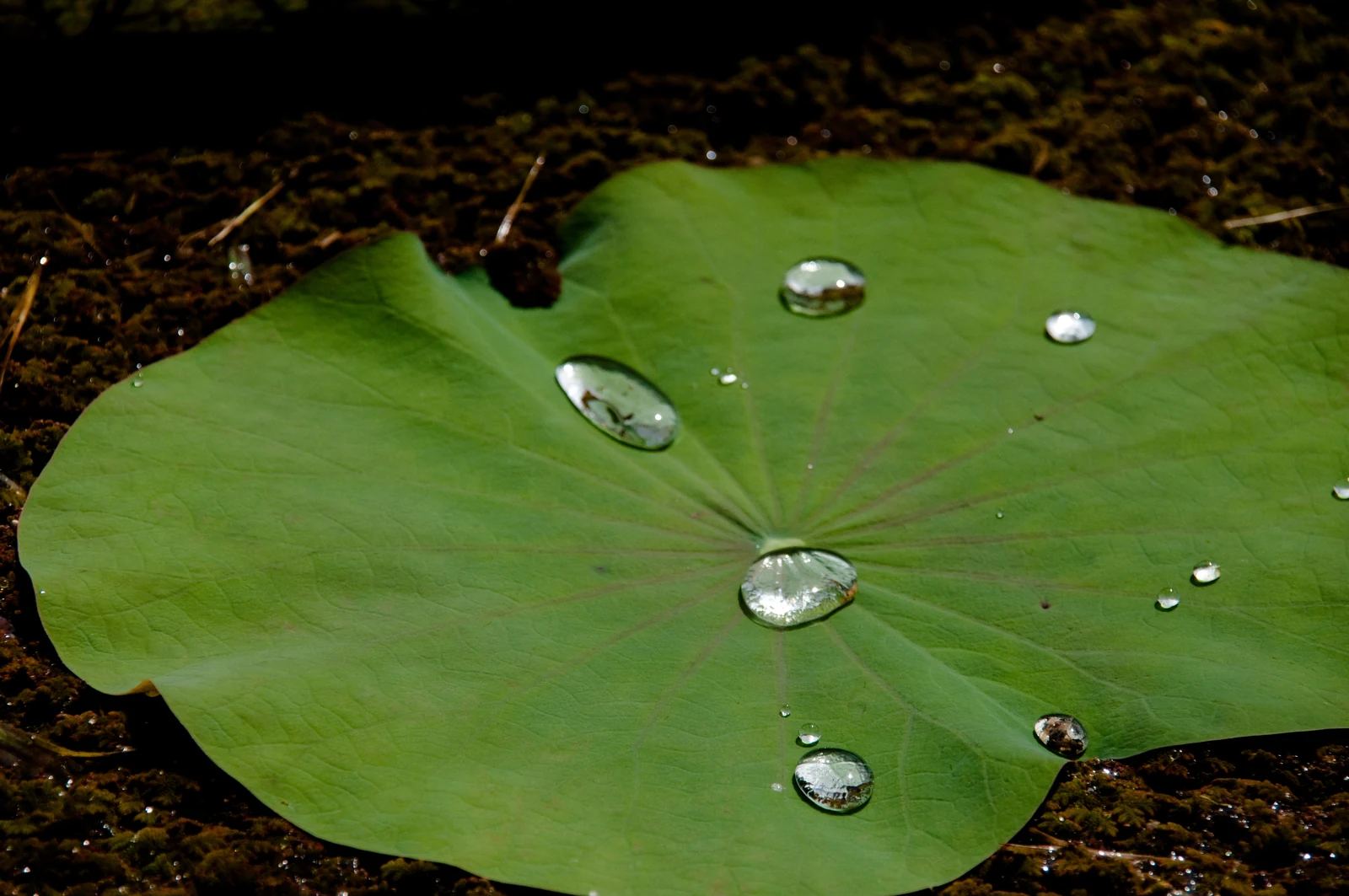
Separate reflective water droplets on a green lotus leaf. Photograph by GJ Bulte; source and CC BY-SA 3.0 license linked at the end of the article.
- Why water gathers into little beads
- The surprise is that smoothness is not the secret
- What “self-cleaning” actually means here
- Read this photograph in three steps
- A bead of water is not a waterproof certificate
- A tiny after-rain challenge: notice three things
- The idea worth borrowing from a leaf
- Photographs and image rights
They look like glass beads scattered across a green plate. But the little jewels on this leaf are water. The interesting question is not just why they look beautiful. Why does the water stay in separate drops instead of spreading out?
A lotus leaf turns that ordinary question into an unusually good science story. We can follow it without equations, then use the photographs to practise a useful skill: separating what a striking image shows from what we imagine it proves.
Why water gathers into little beads
Water molecules attract one another: that is cohesion. Attraction to other materials is adhesion. The USGS Water Science School explains how molecular attraction produces surface tension. A drop does not have a separate transparent skin holding it together, even if it looks that way.
So do not give water the entire starring role. There are two characters in this scene: the liquid and the surface it touches. Saying “water sticks to itself” gets us started, but leaves a question unanswered: why does the same liquid not behave identically on everything?
The surprise is that smoothness is not the secret
You might imagine a surface polished like a mirror. Lotus leaves instead have microscopic bumps covered with wax crystals. The fine structure and waxy chemistry work together; smoothness alone is not the explanation. Electron-microscope images in this 2023 Beilstein Journal of Nanotechnology editorial reveal that structure.
Think of looking at fabric from across a room, then inspecting its weave. Something that appears continuous can hide a busy landscape at a smaller scale. That is a comparison about scale, not a claim that leaves are woven. The large veins visible in these photographs are not the microscopic bumps described by the researchers.
What “self-cleaning” actually means here
A rolling drop can carry particles away. In the abstract of their 1997 study, Wilhelm Barthlott and Christoph Neinhuis connected surface roughness, reduced particle adhesion, and water repellency with self-cleaning. The lotus leaf gave the phenomenon its familiar name: the lotus effect.
The useful word is rolling. A photograph of a stationary bead shows a shape, not a dirt-removal journey. Nor should “self-cleaning” quietly become a promise of sterilisation or removal of every kind of stain. Those are different questions. This is also an established scientific story, not a discovery made in 2026.
Read this photograph in three steps

First, find the boundary: is there a distinct edge or an extended sheet of water? Next, look at the bright patches and shapes within it. Not every pale area is something floating inside the drop; a photograph also records reflections of light and the surroundings.
Finally, ask what is missing. Did this drop move? A single frame cannot tell us. Did it collect dust? We cannot establish that either. This does not spoil the picture. It gives you a better way to enjoy it: describe what is visible before inventing the scene that happened a second earlier.
A bead of water is not a waterproof certificate
If you see droplets on a bag, you can accurately say that water is beading on its surface at that moment. But that observation alone does not establish that you can submerge the bag or that everything inside will stay dry. A surface photograph is not a test of the whole product, its seams, and its zip.
Treat this as a question to bring to an advertisement, not a recommendation for a particular coating: what was tested, under which conditions, and what do the product instructions actually cover? Do not put a phone or another device under water to recreate the scene. Equally, do not use beads on a houseplant leaf as a watering schedule. This story is about a surface, not the roots’ need for water.
A tiny after-rain challenge: notice three things
If you encounter wet leaves somewhere safe, turn a spare minute into a looking game. There is no need to pick a leaf, rub it, or spray an unfamiliar plant. Observe from a dry path, away from pond edges and traffic; children should be accompanied by an adult.
- Choose one drop. Describe it as “rounded and raised” or “wide and flat,” rather than calling every sparkle a lotus effect.
- Watch before photographing. Does it stay still, merge with another drop, or leave your view? Record the event you saw, not the explanation you expect.
- Take a comparison picture if practical. Keep the framing similar and do not move the leaf to manufacture a result. “No change while I watched” is a perfectly valid observation.
Your entire record could be one line: “First leaf: separate beads. Second leaf: water spread out. Movement: could not see any.” That is not a laboratory test that identifies a surface. Its value is making your attention specific, instead of stopping at “wow, shiny water.”
The idea worth borrowing from a leaf
The wider idea is biomimicry: learning from how a natural structure works, rather than simply copying its appearance. The Beilstein editorial connects lotus-effect research with the development of nature-inspired surfaces. Turning that inspiration into a useful material still takes engineering and testing; a beautiful photograph is not a manufacturing specification.
The question is worth keeping: before looking for a stronger material or adding another layer, might a surface detail matter? You do not need to mix a coating in your kitchen. The satisfying part is discovering that an impressive solution can begin with something too small to see.
For another familiar object with a surprising explanation, explore why soap bubbles look like tiny colourful planets, where light takes the leading role. If your interest is the plant itself, try the practical houseplant light guide rather than turning a drop’s shape into care advice.
Photographs and image rights
The cover, Lotus leaf with waterdrops, was photographed by GJ Bulte on 4 December 2010 and is licensed CC BY-SA 3.0. The published image version remains available under that license; this does not relicense the article text. The inline photograph by Daichungus has its source and license linked beneath it. Credit does not imply either photographer’s endorsement.

Both are real photographs, proportionally resized and converted to WebP only; no droplets or generated details were added. The cover version remains available under CC BY-SA 3.0 and the inline photograph under CC BY 4.0, as credited above.