
Octopus Camouflage: It Changes More Than Just Its Color
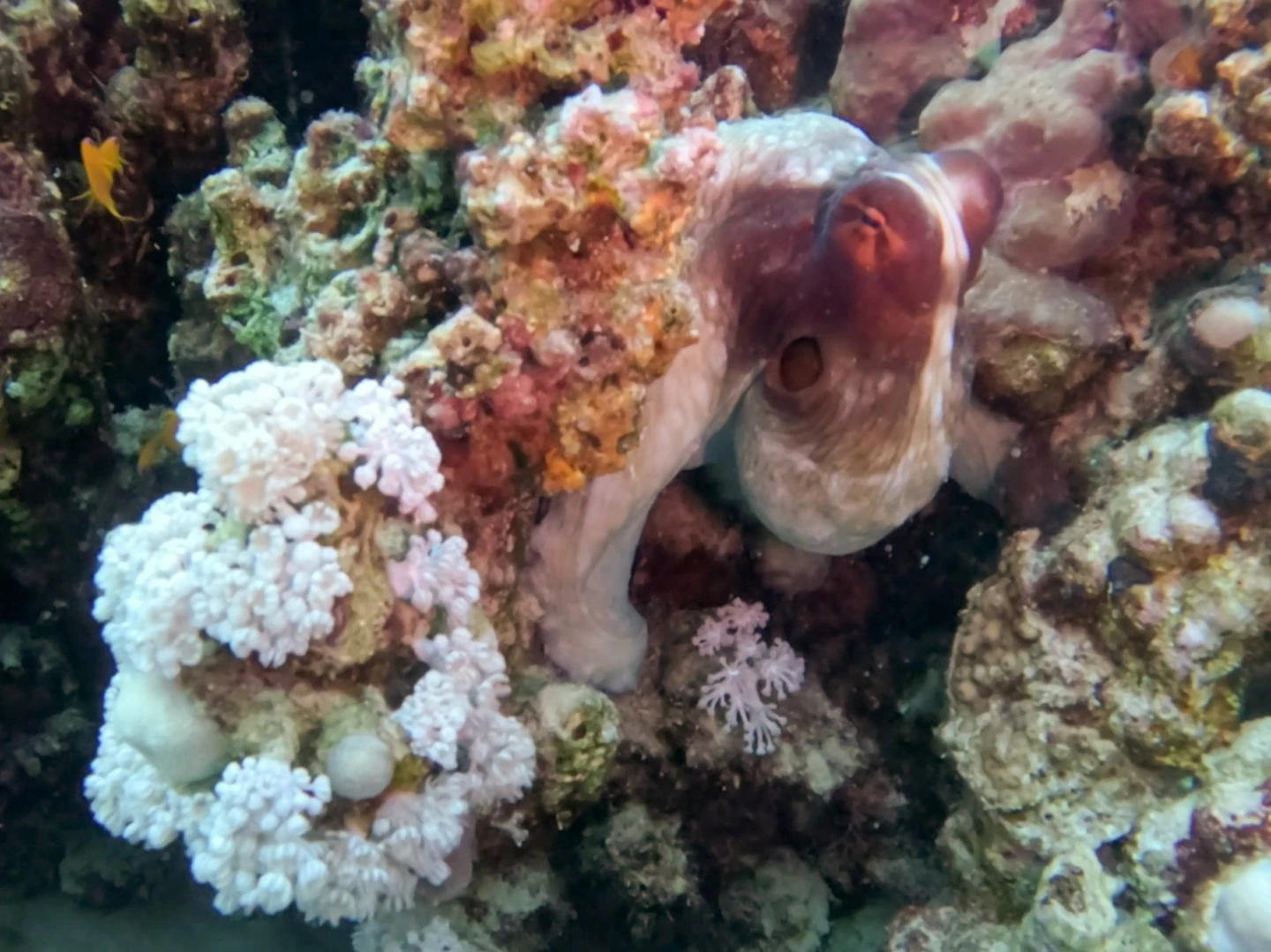
Day octopus (Octopus cyanea) among reef structures in Egypt. Photo: Charlotte Kirchner, via Wikimedia Commons, CC BY 4.0. Proportionate resize and WebP conversion only; source and license below.
- The color change is not a coat of paint
- There is a texture trick, too
- It does not have to copy the whole seafloor
- Read the photograph in three passes
- A different pose changes the picture
- Three claims to question in a viral clip
- Keep the encounter interesting for you—and undisturbed for it
- Image credits and reading notes
Look at the cover photograph for a moment. The eye is relatively easy to find. Now try tracing where the octopus ends and the reef begins. That second task is much less straightforward—and it is the interesting part.
Octopus camouflage is not just a change of color. It can involve the pattern on the skin, its three-dimensional texture and the animal’s outline. Once you start looking for these separately, a familiar “wow, it disappeared” clip becomes something much more satisfying to watch.
The color change is not a coat of paint
The Smithsonian’s guide to cephalopods explains the mechanism: muscles expand pigment-filled sacs called chromatophores, exposing more color; relaxation makes them smaller. Reflective cells also contribute to the skin’s appearance. Think of opening and closing tiny colored umbrellas, not making fresh paint for each background. That umbrella image is an analogy, not the actual shape of the cells.
When watching a clear close-up, follow one small patch rather than the whole animal. Ask whether a dark area expands, a pale area becomes more noticeable, or the pattern changes. Naming what you see is more useful than simply calling every change “turning brown.”
There is a texture trick, too
A flat color filter would leave a smooth object looking smooth. An octopus can do something a filter cannot: alter its skin’s relief. The Marine Biological Laboratory describes raised skin structures called papillae, which help octopuses and cuttlefish create a rougher outline. They can flatten them again.
The detailed nerve-control study discussed in that 2018 report concerns cuttlefish, not proof that every octopus uses an identical control circuit. That distinction matters: these relatives share remarkable abilities, but “scientists studied a cuttlefish” should not quietly become “scientists tested all octopuses.”
It does not have to copy the whole seafloor
Here is the detail worth remembering. In a 2012 field study published in PLOS ONE, researchers analyzed background matching in Octopus cyanea and O. vulgaris. Their results indicated that patterns resembled selected features of nearby objects, rather than the entire surrounding scene.
Picture a busy shelf. A small object need not reproduce every book and ornament to become hard to pick out; resembling a neighboring cluster might be enough to confuse the search. That is a way to understand the finding, not a claim that an octopus consciously plans a disguise like a person arranging a shelf.
It also explains why “Can it match absolutely any background?” is the wrong challenge. The study concerns two species in observed settings, not a guarantee of perfect camouflage on every surface.
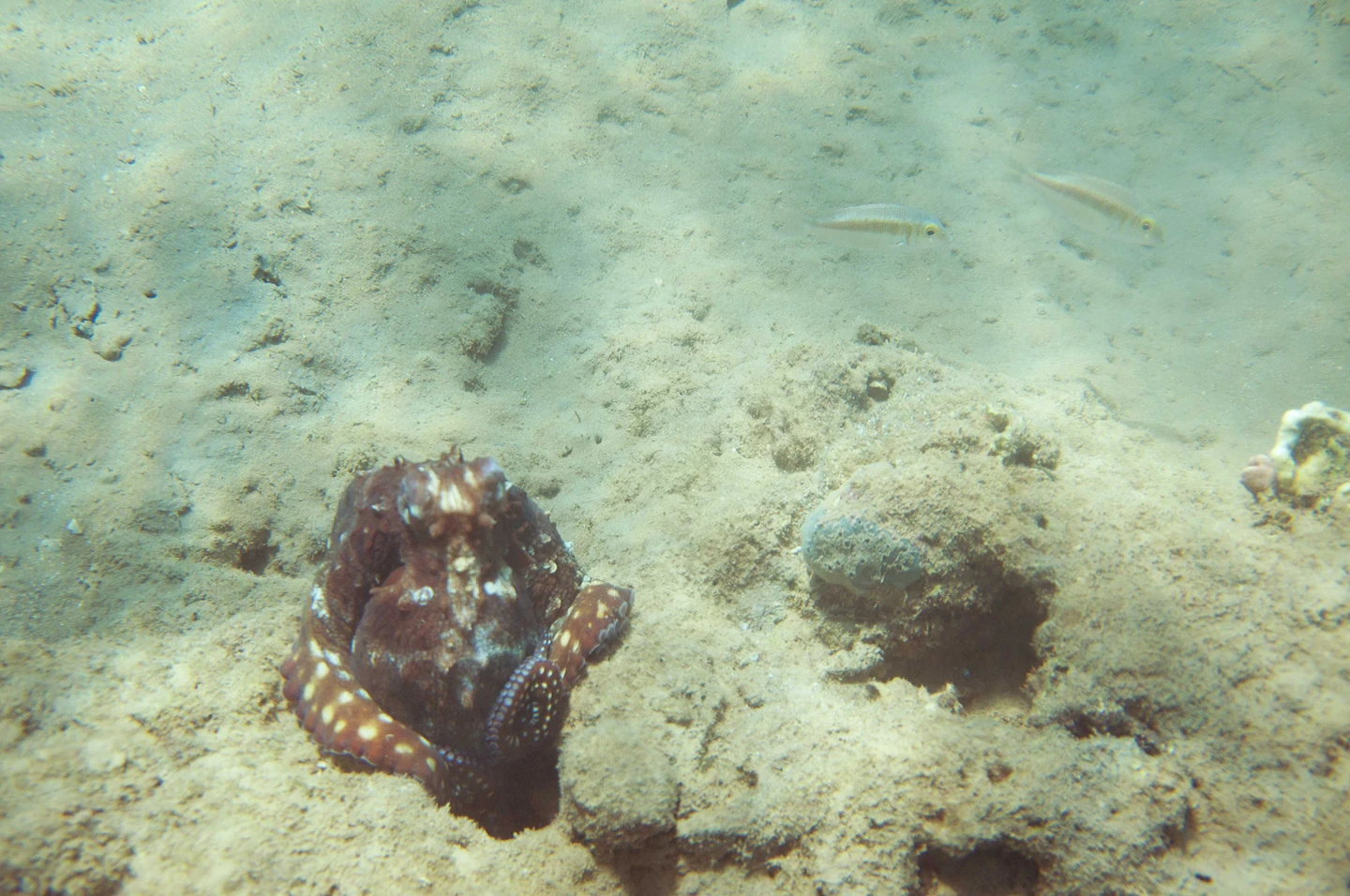
Read the photograph in three passes
Try this with the photograph above before scrolling. It is an observation game, not a scientific camouflage test.
- Find an anchor. Locate the eye or an arm edge. Use it to trace the body without guessing where the animal ought to be.
- Compare patches, not just colors. Notice the pale marks against darker skin, then look at the neighboring rocks. Which areas look broken up, and which stand out?
- Follow the boundary. In this particular frame, the lower edge contrasts with the sand. Recognizing a visible edge does not mean camouflage never works; it means you have found a useful clue in this photograph.
Now return to the cover. Its tighter, more cluttered view makes the same exercise feel different. These are different photographs—not a controlled comparison of the same animal under identical conditions.
A different pose changes the picture
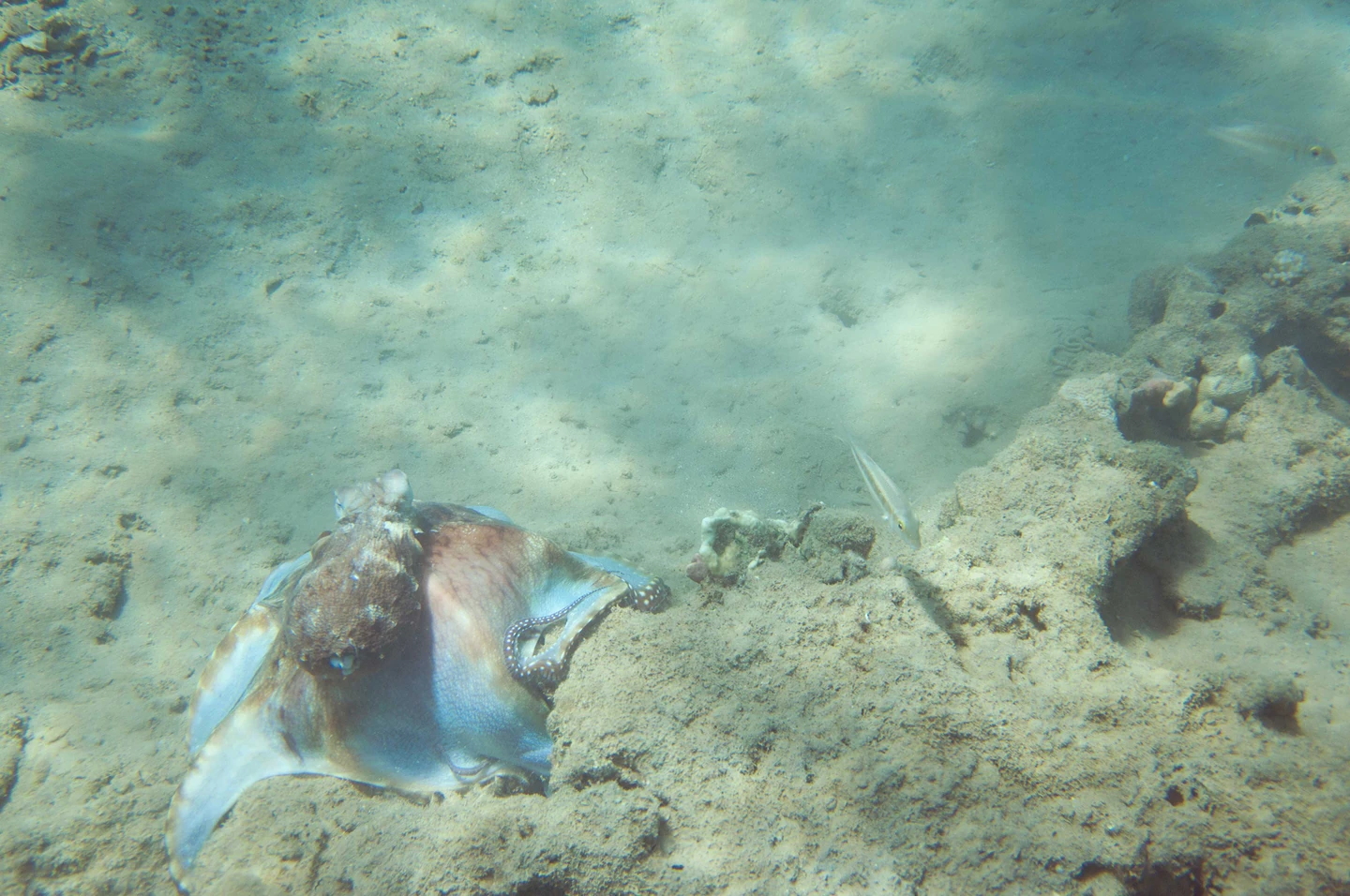
Here the arms are more spread out, and broad pale areas are visible. Rather than treating this as a dramatic “camouflage switched off” reveal, compare the outline: compact in the earlier frame, more open here. The images show different appearances, but they do not establish why the animal changed or how another animal perceived it.
For a simple drawing challenge, sketch just the outside boundary of each pose. Leave out the eyes, suckers and colors. You will have two quite different silhouettes without adding a single painted spot.
Three claims to question in a viral clip
- “It became invisible.” Hard for a viewer to locate is not the same as physically invisible.
- “That color means it is happy.” A caption alone is not evidence of a specific emotion. Look for research and behavioral context before accepting the explanation.
- “It changed instantly.” A continuous shot is more informative about timing than two edited frames. Camera angle, lighting and editing should not be mistaken for measured biology.
There is no need to drain the wonder out of the footage. A better question simply makes it richer: what changed, what stayed the same, and what evidence would distinguish the possible explanations?
Keep the encounter interesting for you—and undisturbed for it
If you encounter marine wildlife, watch without touching, chasing, feeding or blocking its way. NOAA’s ocean-etiquette guidance recommends keeping your distance and using zoom rather than approaching. Do not provoke a color change to recreate a video.
The best takeaway is not “a magical animal can look like anything.” It is that camouflage has several layers, and noticing them is a skill you can practice with an ordinary photograph.
Want another animal story that rewards a closer look? Read about the axolotl’s remarkable regeneration—and its shrinking wild home. For another color surprise, see why sunsets on Mars can look blue.
Image credits and reading notes
Cover: Charlotte Kirchner, Octopus cyanea in Egypt, March 5, 2025, CC BY 4.0. Proportionate resize and WebP conversion only; the prepared image retains CC BY 4.0. The two inline photographs are credited individually. No photographer’s endorsement is implied.
This is an evergreen visual explainer, not news of a new discovery or a report of a Dajran dive. Scientific references are linked beside the claims they support; the photo-reading activities are editorial suggestions, not research results.
Both language versions use the same three real photographs, with proportionate resizing and WebP conversion only, without generated elements or color changes. Each prepared file retains its stated license. These images are not a scientific test or a verified before-and-after comparison.





What do you think?
Share your thoughts or experience. Keep the conversation kind and on topic.
Participation Rules
نريدك أن تكون مصدرًا لزملائك من القراء ونأمل أن تستخدم قسم التعليقات لإجراء ذلك. لقد صممناها لرفع وتوسيع الاستجابات الأكثر ذكاءً وإدانةً ، وتقليل أو إخفاء الأسوأ. هذه هي قواعد الطريق:
ابقى في صلب الموضوع
عند تقديم تعليق ، لا تخرج عن الموضوع. لا تعلق على المعلقين الآخرين أو معتقداتهم السياسية المفترضة. ناقش مزايا القصة نفسها. لا تنشر تومي. هذا ليس المكان المناسب لصق فصل من رسالتك (أو أي شخص آخر) أو ورقة بيضاء.
أظهر الإحترام.
نحن نشجع ونقدر النقاش العميق. ما عليك سوى التأكد من أنه عندما لا تتفق مع فرضية القصة أو أي معلق آخر ، فإنك تفعل ذلك بطريقة محترمة ومهذبة.
كن مهذبا وحافظ على نظافته
نحن نغطي التكنولوجيات الجديدة موقعنا ليس منفذاً للفظاظة. نحن لا نتسامح مع الإهانات الشخصية ، بما في ذلك استدعاء الأسماء أو العنصرية أو التمييز الجنسي أو الكلام الذي يحض على الكراهية أو الفحش. هذا يعني أنه لا توجد أي ملاحظات بذيئة أو مسيئة أو مضايقة أو تنمر. إذا لم تكن مدنيًا ومهذبًا ، فلا تنشره.
تجاهل المتصيدون
أفضل رد على القزم - شخص ما يتكرر عدائيًا واستفزازًا - ليس ردًا. من فضلك لا تشجع السلوك السيئ عن طريق الاستجابة ؛ انها لا تخدم سوى لسرور المتصيدون والبيض عليها. إذا كان هناك شخص ما يسيء استخدام موضوع مناقشة ، فأبلغ عن أي تعليقات مسيئة ، وسنتناول الموقف.
كن مسؤولاً وأصيلاً
انشر آرائك فقط بكلماتك الخاصة. أنت مسؤول عن المحتوى الذي تنشره.
لا تنشر رسائل غير مرغوب فيها أو إعلانات
إذا لم يكن لديك عقد إعلان معنا ، فإن هذا الموقع الإلكتروني ليس عبارة عن لوحة إعلانات لنشاطك التجاري. لا تنشر محتوى غير مرغوب فيه أو محتوى ترويجي ذاتي أو حملات إعلانية. لا ضغط أو تجنيد أو استجداء.
نقرأ التعليقات
على الرغم من أن مجالس مناقشاتنا لا تخضع للإشراف الرسمي ، إلا أننا نولي اهتمامًا وثيقًا بها. نحتفظ بالحق في تعديل أو حذف التعليقات التي لا تلبي معاييرنا.
نحن نحظر الأعضاء الفاضحين
إنه ليس شيئًا نتمتع به. ولكن عند الضرورة ، سنحظر الأعضاء الذين لا يلتزمون بهذه الإرشادات.
شكرا على اتباع هذه المبادئ التوجيهية.