Kintsugi: When a Crack Becomes the Best Part of a Bowl
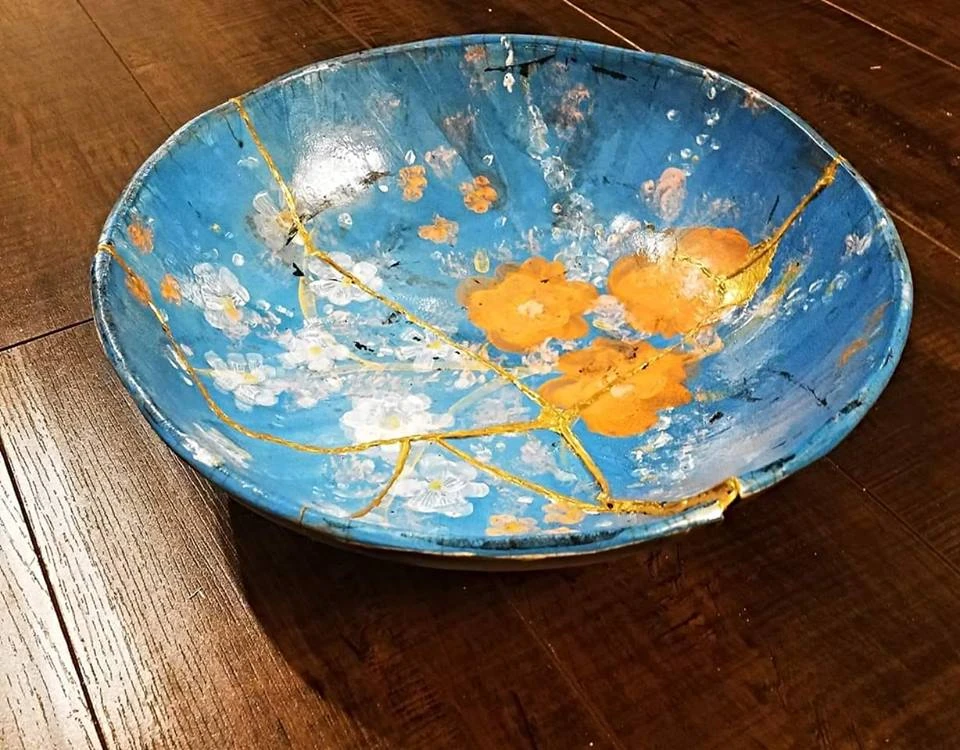
Blue floral bowl with gold repair lines: contemporary work by Ruthann Hurwitz. Photograph via Wikimedia Commons, CC BY-SA 4.0; converted to WebP only.
- What is kintsugi, exactly?
- A thirty-second way to look at a repaired bowl
- Two museum pieces that change the picture
- The repair can be very small
- The repair can share the stage with decoration
- Why a gold repair kit is not the whole story
- Three ways to give a repaired piece room to shine
- Four questions before buying or using one
- If the broken bowl matters to you, pause before the glue
- Cover photograph and image rights
The gold line is the part you notice first. Only then do you realize what you are looking at: a bowl that has broken, been repaired, and kept the evidence.
In the blue bowl above, the flowers already give your eyes plenty to follow. Yet the irregular gold seams cut across the decoration and become a second drawing. They do not belong to the painted pattern. That small interruption is what makes you look again.
This is the appeal of kintsugi: repair can be visible and interesting instead of something we politely ignore. Here is how to enjoy it beyond the familiar “beauty in broken things” slogan—and what to check before bringing a repaired piece home.
What is kintsugi, exactly?
Kintsugi is a Japanese term for gold joinery, associated with repairing ceramics using lacquer and gold. The Cleveland Museum of Art describes the technique alongside a repaired cup in its collection. The point is not simply to paint a gold squiggle onto an intact bowl: there is an actual repair to notice.
One material worth knowing is urushi. As the V&A explains, it comes from tree sap that is refined into lacquer. That is a different starting point from a modern epoxy adhesive, even when the finished seams look similar in a photograph.
You do not need to memorize craft terminology to enjoy a piece. But understanding that there are different materials stops a beautiful image from becoming a misleading description.
A thirty-second way to look at a repaired bowl
Try this with the cover image. First follow the painted flowers. Then follow only the gold. Finally, let your eyes move between the two. The decoration and the repair tell different visual stories on the same surface.
- Look for interruptions. Does a line cross an existing flower, a smooth patch of glaze, or the rim? That intersection is often more interesting than the amount of gold.
- Look at the spaces around it. A tiny repair on a quiet surface can draw as much attention as several seams on a busy one.
- Separate observation from assumption. You can describe a warm, branching line. You cannot establish its exact metal content, age, or food-contact suitability from its color.
This is a looking exercise, not a test of authenticity. Think of it as giving the object a few seconds before reaching for the label.
Two museum pieces that change the picture
The repair can be very small
This Korean cup is dated to the 1100s–1200s in the museum record. Notice the small repaired area on the rim, rather than a dramatic web across the whole vessel. The date of an object is not automatically the date of its repair.
Visually, the contrast is lovely: repeating curves, a restrained surface, then one bright interruption. You do not need a shattered-looking object to appreciate visible repair.
The repair can share the stage with decoration

The record for this bowl identifies Chinese-style decoration and cracks repaired with gold. Let the small warm detail near the rim catch your eye, then step back to enjoy the painted pattern. The repair does not have to dominate every other feature.
Compare both images before scrolling on: which holds your attention longer—the nearly quiet cup or the patterned bowl? There is no correct answer. That preference is useful when choosing art for your own space.
Why a gold repair kit is not the whole story
The word kintsugi appears on modern products as well as craft descriptions. For a concrete example, the V&A shop lists a repair kit containing epoxy glue, epoxy putty, and gold powder. It is not the same material recipe as urushi-based work.
That distinction need not turn into an argument about which object you are allowed to like. It is a reason to ask for a precise description. “Decorative epoxy repair,” “urushi lacquer repair,” and “gold-colored painted effect” communicate different things. A seller should be able to explain what they mean rather than relying on the romance of the name.
Three ways to give a repaired piece room to shine
These are display ideas, not rules about Japanese interiors:
- Give it a quiet neighbor. Try a plain book or an undecorated vase beside a patterned bowl. If everything on the shelf is shouting, its delicate lines get lost.
- Leave some empty shelf. One piece with breathing room can be more satisfying than a cluster of gold accessories competing for attention.
- Choose the angle before the extras. Find a stable position where you can see the repair, rather than balancing the object precariously to show every seam. No arrangement is worth a second accident.
You can try the composition with an intact bowl you already own. Do not break pottery to create a more photogenic display.
Four questions before buying or using one
- What was repaired? Ask for clear photographs of the relevant area, including the inside where possible.
- What materials were used? Ask about the adhesive or lacquer and the finish. A gold appearance alone is not a material specification.
- Is it intended for display or food use? Get instructions for that particular piece. Do not infer suitability for hot tea from a product being called a cup.
- What care does the repair require? Ask about cleaning, heat, and handling, and keep the answer with the object.
For old or undocumented repairs, a cautious display-only approach makes more sense than experimenting with dinner. The Canadian Conservation Institute advises keeping repaired collection objects away from heat and not using them for food or drink. This conservation guidance is not a certification system for every modern maker.
If the broken bowl matters to you, pause before the glue
A family piece is not a good place for a first attempt. The Canadian Conservation Institute warns that amateur repairs and unsuitable adhesives can cause lasting damage; restoration of valuable or fragile ceramics belongs with a conservator. An old repair can also be part of an object’s history, so do not strip it off merely because it looks untidy.
There is a gentler takeaway here than “everything broken becomes better.” Some things need expert help; some are worth keeping without becoming useful again. A repaired bowl can still be beautiful without proving that damage was a good thing.
If you enjoyed slowing down to notice one detail, try the painted curtain that fools your eyes in trompe-l’oeil art, or light painting with a small light. Both offer another way to make an ordinary-looking surface surprising.
Cover photograph and image rights
The cover shows a contemporary kintsugi-style bowl by Ruthann Hurwitz, via Wikimedia Commons. The photograph is shared under CC BY-SA 4.0; our WebP version remains under that license. The two museum images have separate rights statements in their captions. Image credit does not imply endorsement of this article.

These are real photographs, not AI-generated images. Preparation used proportional resizing and WebP conversion only, preserving the full frames. Both language versions use the same images; source and license links appear above.