A Jigsaw Puzzle Night People Actually Want to Join
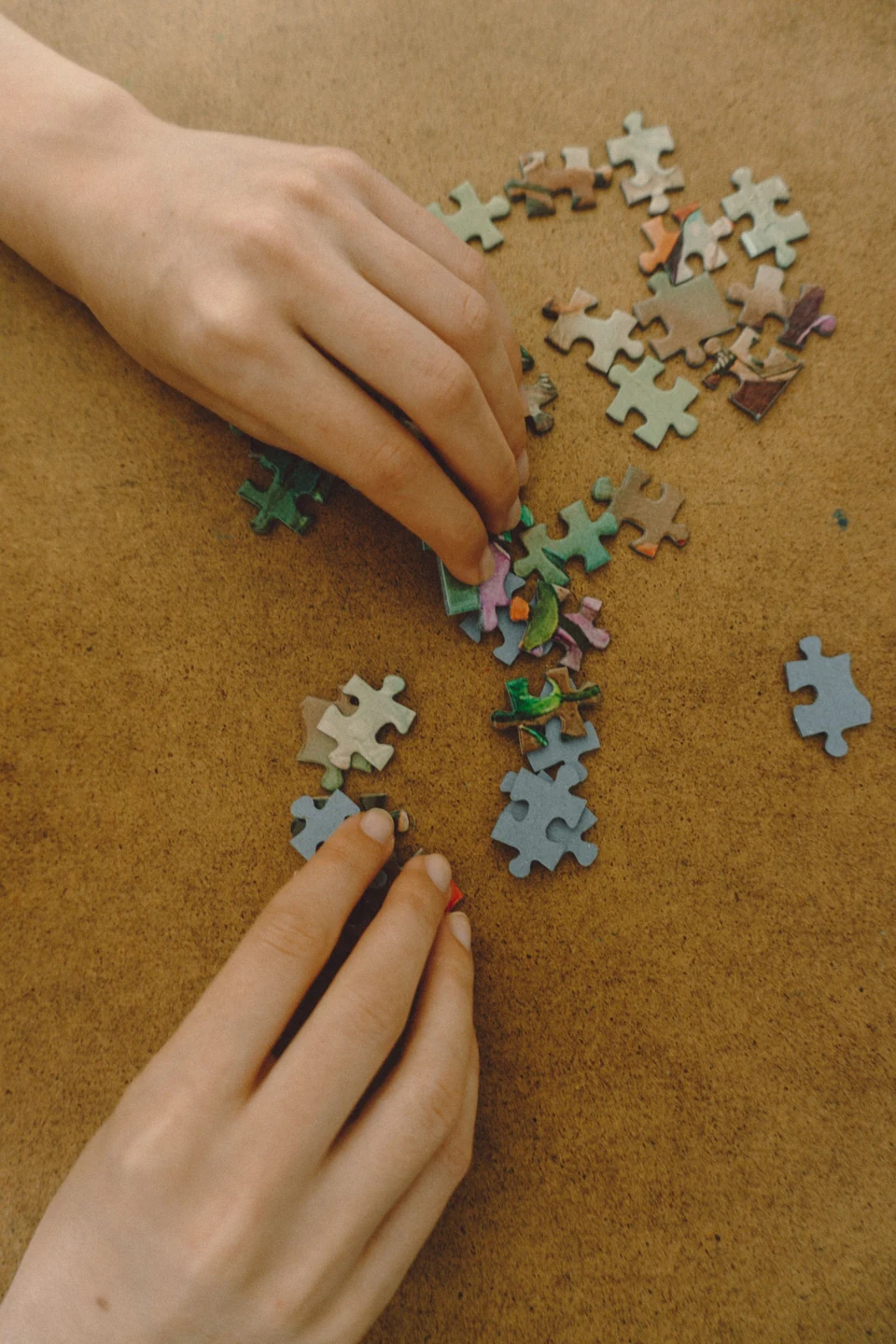
Hands arranging jigsaw pieces on a wooden surface. Photo: Berna / Pexels; illustrative, not a session we tested.
- Choose a picture people want to join
- Set up for people, not just pieces
- Give everyone a small, clear starting task
- Help without taking over
- When nothing fits, change the job
- Leave room for conversation—and silence
- Finish the evening, not necessarily the puzzle
- A copyable plan for tonight
- Sources and photographs
Picture a table covered in jigsaw pieces. One person is happily turning them over; another is waiting to discover where to begin. Then somebody spots part of a window, and the evening gets its first satisfying line: “I think I have the piece you need.”
A puzzle night need not turn everyone into an expert. It can simply give friends or family something to do together, without a host rushing around or an uninvited competition. Here is a practical way to plan one with a puzzle you already own—not a shopping list for an enormous new challenge.
Choose a picture people want to join
Start with the people around the table. Have they done many puzzles? Do they enjoy tiny details, or prefer seeing a recognizable section come together quickly? Ask rather than choosing a difficult box to impress them. For newcomers, a smaller, appealing puzzle may be a better invitation than a project that consumes the evening.
Ravensburger’s explanation of puzzle difficulty notes that piece count is only one factor: size, cut, color variation and image detail also matter. This is guidance from a puzzle manufacturer, not an independent comparison of brands.
Imagine two pictures with the same piece count: a street of different shopfronts and a tiny pattern repeated everywhere. The first offers a red door or a distinctive awning to work on; the second may offer fewer obvious starting places. That is an illustrative comparison, not a test we conducted. Difficulty does not have to be the main attraction.
Set up for people, not just pieces
Check the finished dimensions on the box and allow room for loose pieces and people's hands as well as the picture. Put the reference image where everyone can see it. If one person controls the box lid, the others may lack information rather than ability.
Ravensburger’s speed-puzzling guidance includes sufficient space and bright, even lighting. We are borrowing the setup advice, not turning the gathering into a championship. Your guests do not need a stopwatch.
Try sitting on each side beforehand. Is glare hiding the picture? Must somebody stand to reach their area? Adjust the position or lighting rather than asking a guest to endure an awkward seat. Keep drinks away from the working area. A dedicated mat or board is not a prerequisite; use what suits your space. If children join, follow the product's age recommendations and warnings, and keep small pieces away from little ones who may put them in their mouths.
Give everyone a small, clear starting task
Before emptying the box, agree on a light goal: “Let's build one recognizable section, then see whether we want to continue.” Avoid promising to finish within an hour. You do not yet know how this group will enjoy the task.
With a conventional rectangular puzzle, someone can collect border pieces while others look for lettering or a distinctive part of the scene. Edges are not a universal rule: circular puzzles and unusual cuts may need another starting point. What matters is giving a newcomer something clearer than a heap and “Just find a piece.”
Keep the jobs flexible. One person could gather lettering, another find the pieces of a bright window, and another compare them with the reference. Swap when someone wants a change. Sorting and noticing details count as participation too; a person's contribution is not a tally of pieces placed alone.
Help without taking over
You may recognize a piece before your friend does. Leave room for their attempt, or ask, “Would you like a hint, or another moment to try?” Taking it from their hand and placing it quickly completes a move but can turn a participant into an audience.
Try ordinary, adaptable lines: “I've found something that looks like your section,” “Shall we swap areas?” or “I'll leave that part with you if you're enjoying it.” These are hosting suggestions, not therapeutic rules. Watching or chatting should be acceptable choices too.
Agree on another small courtesy: do not dismantle someone else's section without explaining what looks wrong. Compare the printed image and the fit together, and do not force pieces into place. If the problem remains unclear, leave that section aside and return later.
When nothing fits, change the job
A few minutes may pass without a single successful connection. Instead of deciding that somebody is bad at puzzles, change the question. Which section do we actually recognize? Have we looked for a line or a letter rather than color alone? Would spreading out a few pieces help more than searching the pile?
Two people can change sides, collect a small group away from the main picture, or take a break. Do not turn the break into a test of anyone's concentration. If nobody is enjoying the activity, choosing something else is better than defending the evening's original plan.
Leave room for conversation—and silence
The picture can supply a gentle opening: “Does anywhere here remind you of our neighborhood?” or “What scene would we pick next?” A long list of personal questions can make the table feel more like an interview than a visit.
There may also be a quiet stretch when everyone is absorbed. Ask whether people are comfortable rather than treating silence as social failure. Avoid interrupting every few minutes to document the occasion. Ask before photographing people or sharing their names; a picture of the puzzle itself can be enough to remember the idea.
Finish the evening, not necessarily the puzzle
Decide beforehand what will happen when you stop. If the table is needed for dinner, do not start something with nowhere to keep it. Use a suitable, stable surface if you have one, or choose a puzzle you can comfortably pack away. Avoid carrying a large unfinished puzzle on an unstable improvised board.
Notice what actually happened: a section of tree, a readable sign, or a better way of sharing the task. Put loose pieces into a closed container and, if you intend to continue, take a reference picture of the work. “Next time, let's choose an easier picture” can be an entirely sensible conclusion.
An invitation is an offer, not an obligation. Accept that somebody may dislike this kind of game; declining is not a test of friendship. Our guide to saying no clearly and kindly covers that separate conversation.
A copyable plan for tonight
Write down five answers before buying anything:
- Who is joining? Who would prefer larger pieces or a less demanding picture?
- Which image? Why does your group like it, beyond the number on the box?
- Where will it go? Is there room to sit, sort and either store the work or pack it away?
- What is the first task? Pick an obvious section or small job that someone can join.
- How does the evening end? An approximate time or a shared decision—not compulsory completion.
A possible invitation: “Fancy trying the puzzle I have on Saturday evening? We can do a bit, and if it's not our thing, leave it and catch up.” Choose a time that genuinely suits you both. If starting the conversation is harder than planning the activity, see how to reconnect without waiting for a perfect message.
The useful finish line is not a complete picture at any cost. It is a table where people found a place and might like to sit again.
Sources and photographs
Manufacturer guidance is linked where used. The hosting plan, examples and suggested phrases are our editorial contribution, not evidence that puzzles raise intelligence, treat a health problem or guarantee stronger relationships. No brand recommendation or product test is implied.
Cover: Berna / Pexels; interior photograph: DS stories, credited beside it. Both are real photographs used under the Pexels License, not a gathering we documented or personal stories about the pictured people. No photographer endorsement is implied.
Both languages use the same two real photographs, preserving their full frames and proportions with resizing and WebP conversion only. The hosting plan and examples are editorial suggestions, not a study or a documented trial.