
How to Review Your Chess Games as a Beginner: Turn One Mistake into a Useful Lesson

An illustrative chess photograph; the original instructional diagram inside the article does not depict an actual match. M1DDL3 M7N / Pexels, Pexels License.
- Choose a game you can actually remember
- Make your own first pass before using an engine
- Use the engine to answer a question, not deliver a verdict
- A worked example: recognise a fork without declaring victory
- Name the cause of the mistake
- Keep a small review notebook
- Try a manageable review routine
- Image and usage credit
You finish a chess game, open the analysis and see a string of mistakes. Then you play another game and repeat them. The missing step is often not a stronger engine: it is turning one position into a lesson you recognise next time.
For beginners learning chess, a short, focused review can make a finished game useful even after a loss. The routine below is an editorial practice plan, not a promise of a particular rating increase. It assumes you already know how the pieces move. If not, start with our flexible beginner chess plan.
Choose a game you can actually remember
Start with one completed game in which you had enough time to think. A frantic series of one-minute games may leave you remembering little beyond the final mistake. Save the move record or PGN if available. Write down the moment that felt uncomfortable before you forget why: a threatened piece, an unexpected check, or a trade you could not evaluate.
Do not review only losses. Winning can hide a poor decision that your opponent failed to punish. Equally, a loss after a reasonable decision is not proof that the entire game was bad. Separate the quality of a decision from the final result.

Make your own first pass before using an engine
Replay the game without analysis suggestions. Stop at three moments: the first decision you did not understand, a position where material changed, and a moment when time pressure affected your choice. For each, write your original idea in plain language. “I moved the bishop to attack the rook” is more useful than “that move was terrible.”
Ask what the opponent threatened, which pieces were undefended, and whether a check or capture changed the situation. Then choose one alternative move and calculate a short reply. You are not trying to solve every position perfectly. You are recording your thinking so that later analysis has something specific to correct.
Use the engine to answer a question, not deliver a verdict
After that first pass, open an analysis tool such as the Lichess analysis board. Compare your candidate with the suggested continuation. Play through the replies rather than memorising the first move. If you cannot explain the suggestion, keep it as a question instead of pretending the lesson is complete.
For example, ask “Why does my knight move lose a piece?” Then look for the intervening check or capture. A changing evaluation number by itself does not teach you which threat you missed. A single understandable sequence is more useful for this review than collecting ten unexplained labels.
Keep this work separate from live play. Lichess’s fair-play rules prohibit engine assistance during ongoing real-time games against other players, whether rated or casual. This guide concerns finished games, not getting help while playing.
A worked example: recognise a fork without declaring victory
Set up this deliberately simplified exercise: White king on h1 and knight on d5; Black king on g8, queen on a6 and rook on c6. Every other square is empty. White moves the knight from d5 to b4, written Nb4. The diagram shows the position after that move, so Black is now to move.
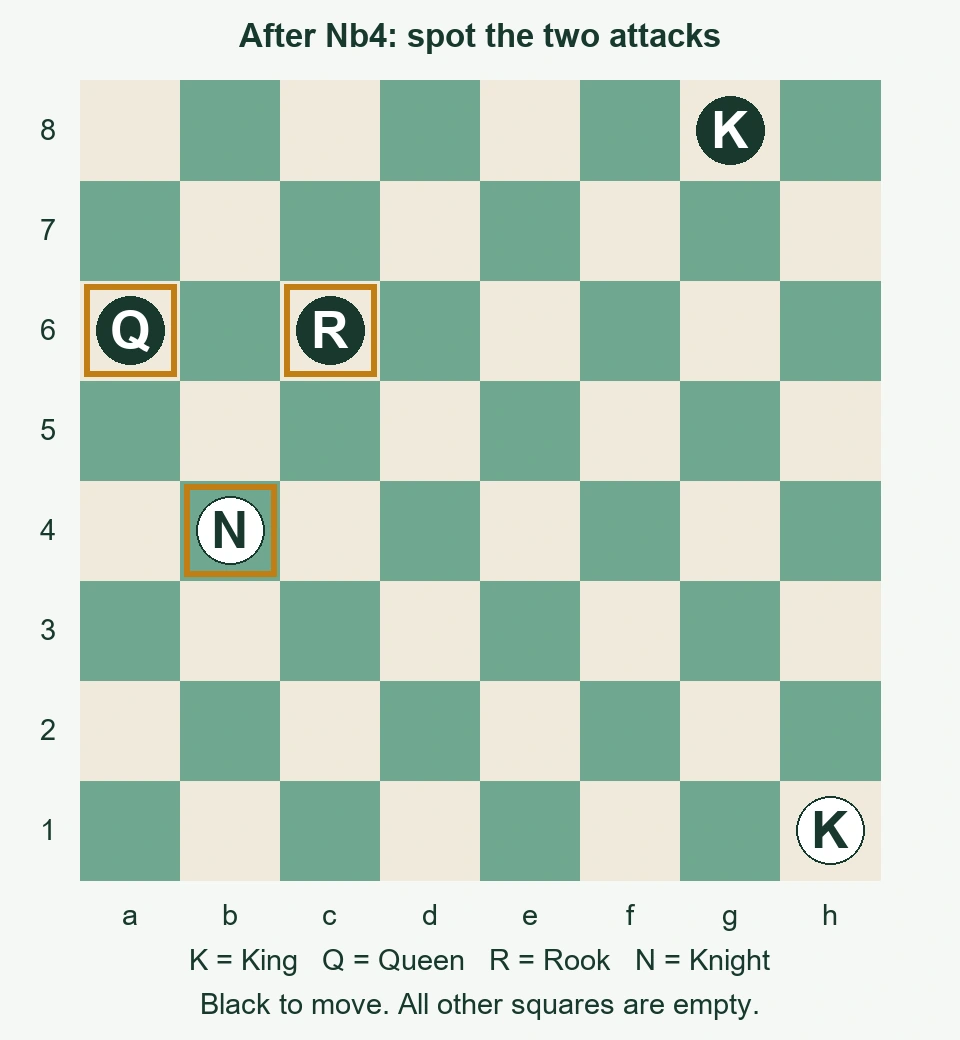
From b4, the knight attacks both a6 and c6: two files-and-ranks away in its L-shaped pattern. That is a fork of the queen and rook. But a fork is an observation, not automatically a forced win. Black can look for a checking reply; for example, the rook can move from c6 to c1 with check along the first rank. White must respond legally to that check before acting as though taking the queen is guaranteed.
The useful note is not merely “play Nb4.” It is: “I can recognise two knight targets, but I must check the opponent’s forcing replies.” In your own review, use the same distinction between spotting a tactical idea and checking whether it works in the full position.
Name the cause of the mistake
“Blunder” is a label; it is not a diagnosis. Give the error a cause you can act on:
- Missed threat: you looked only at your attack and ignored theirs.
- Loose piece: a piece had no defender when the position opened.
- Calculation stopped early: you saw your move but not the opponent’s check or capture.
- Time management: you spent too long on an easy move and rushed a critical one.
- Knowledge gap: you did not understand a basic ending or a piece’s movement.
Choose the clearest cause, not all five. If you repeatedly miss undefended pieces, another opening video may not address the problem. A pause to count attackers and defenders before moving is a more relevant experiment.
Keep a small review notebook
Use one entry per game: date and time control; the position or move number; what you intended; the reply you missed; one corrected lesson; and an exercise to try. For the fork example, the exercise might be “before choosing a capture, list the opponent’s checks.” Do not fill the notebook with entire engine variations you cannot explain.
Review three recent entries before your next session. If the same cause appears, practise that theme. If the causes differ, start with the one you understand most clearly. A notebook is useful when it changes the next decision, not when it merely becomes a catalogue of mistakes.
Try a manageable review routine
As a starting experiment, allow roughly five minutes for your own replay, five for checking one position, and a few more for writing the lesson. These are flexible time limits, not an evidence-based optimum. If a position is complicated, save it and revisit it rather than forcing an explanation.
Before the next game, choose one habit: check the opponent’s threat, count defenders, or slow down before a trade. Afterwards, ask whether you actually used it. Progress is not only a rating graph; it can also be recognising the same danger sooner. Keep the review small enough that you will do it again.
Image and usage credit
An illustrative chess photograph; the original instructional diagram inside the article does not depict an actual match. M1DDL3 M7N / Pexels · Pexels License Resized and converted to WebP; use does not imply the creator’s endorsement.



What do you think?
Share your thoughts or experience. Keep the conversation kind and on topic.
Participation Rules
نريدك أن تكون مصدرًا لزملائك من القراء ونأمل أن تستخدم قسم التعليقات لإجراء ذلك. لقد صممناها لرفع وتوسيع الاستجابات الأكثر ذكاءً وإدانةً ، وتقليل أو إخفاء الأسوأ. هذه هي قواعد الطريق:
ابقى في صلب الموضوع
عند تقديم تعليق ، لا تخرج عن الموضوع. لا تعلق على المعلقين الآخرين أو معتقداتهم السياسية المفترضة. ناقش مزايا القصة نفسها. لا تنشر تومي. هذا ليس المكان المناسب لصق فصل من رسالتك (أو أي شخص آخر) أو ورقة بيضاء.
أظهر الإحترام.
نحن نشجع ونقدر النقاش العميق. ما عليك سوى التأكد من أنه عندما لا تتفق مع فرضية القصة أو أي معلق آخر ، فإنك تفعل ذلك بطريقة محترمة ومهذبة.
كن مهذبا وحافظ على نظافته
نحن نغطي التكنولوجيات الجديدة موقعنا ليس منفذاً للفظاظة. نحن لا نتسامح مع الإهانات الشخصية ، بما في ذلك استدعاء الأسماء أو العنصرية أو التمييز الجنسي أو الكلام الذي يحض على الكراهية أو الفحش. هذا يعني أنه لا توجد أي ملاحظات بذيئة أو مسيئة أو مضايقة أو تنمر. إذا لم تكن مدنيًا ومهذبًا ، فلا تنشره.
تجاهل المتصيدون
أفضل رد على القزم - شخص ما يتكرر عدائيًا واستفزازًا - ليس ردًا. من فضلك لا تشجع السلوك السيئ عن طريق الاستجابة ؛ انها لا تخدم سوى لسرور المتصيدون والبيض عليها. إذا كان هناك شخص ما يسيء استخدام موضوع مناقشة ، فأبلغ عن أي تعليقات مسيئة ، وسنتناول الموقف.
كن مسؤولاً وأصيلاً
انشر آرائك فقط بكلماتك الخاصة. أنت مسؤول عن المحتوى الذي تنشره.
لا تنشر رسائل غير مرغوب فيها أو إعلانات
إذا لم يكن لديك عقد إعلان معنا ، فإن هذا الموقع الإلكتروني ليس عبارة عن لوحة إعلانات لنشاطك التجاري. لا تنشر محتوى غير مرغوب فيه أو محتوى ترويجي ذاتي أو حملات إعلانية. لا ضغط أو تجنيد أو استجداء.
نقرأ التعليقات
على الرغم من أن مجالس مناقشاتنا لا تخضع للإشراف الرسمي ، إلا أننا نولي اهتمامًا وثيقًا بها. نحتفظ بالحق في تعديل أو حذف التعليقات التي لا تلبي معاييرنا.
نحن نحظر الأعضاء الفاضحين
إنه ليس شيئًا نتمتع به. ولكن عند الضرورة ، سنحظر الأعضاء الذين لا يلتزمون بهذه الإرشادات.
شكرا على اتباع هذه المبادئ التوجيهية.