Not Paint, Just Light: Why Soap Bubbles Look Like Tiny Planets
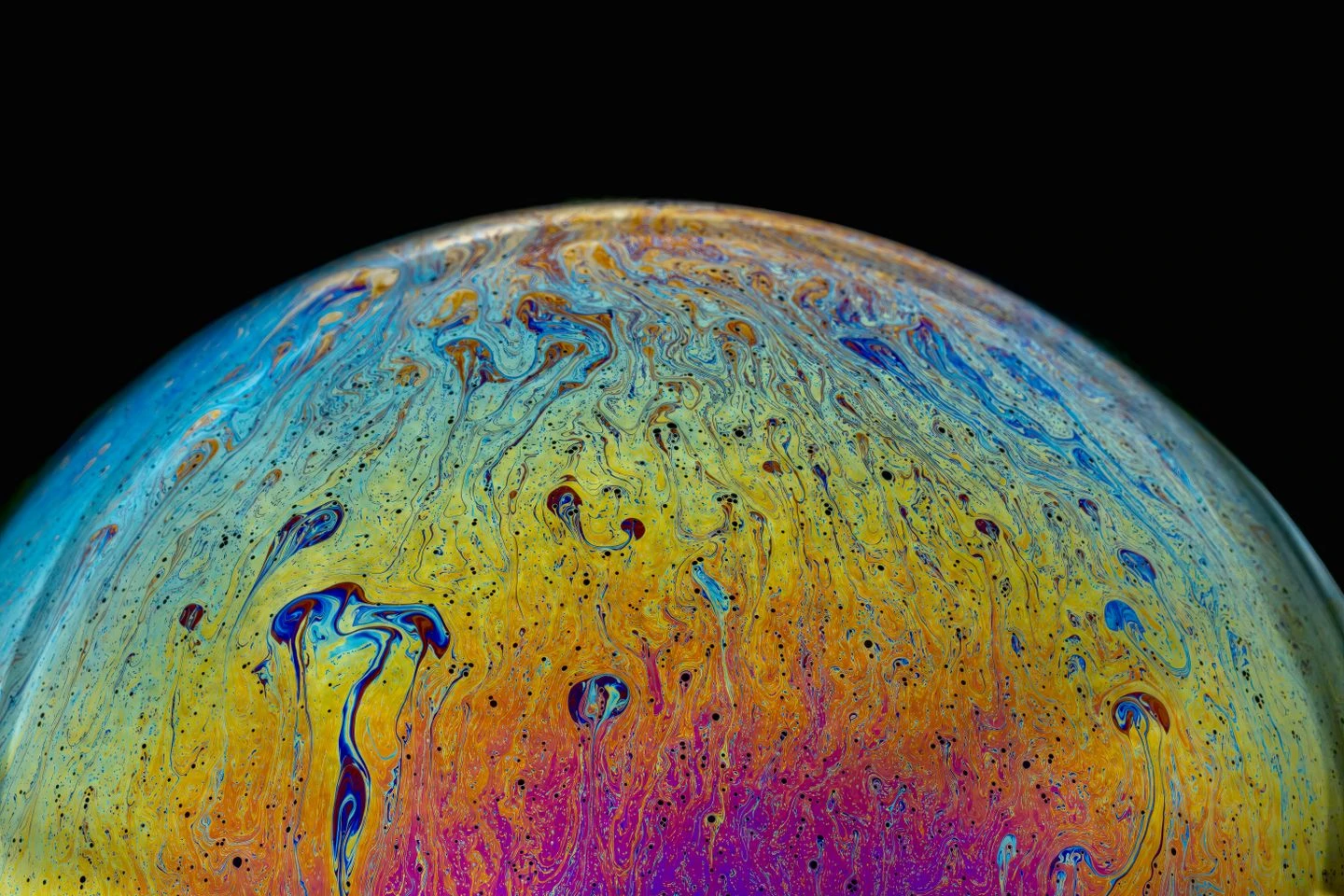
Iridescent detail on a soap bubble, not a planet. Photo by Rafael Minguet Delgado via Pexels.
It could be a planet photographed through a telescope: dark edges, luminous bands, a swirl that looks like a small storm. Then you discover the subject is a soap bubble. The surprising part is not just how beautiful it looks. Those shifting colors do not need colored paint.
A familiar toy can become a very good reason to stop scrolling and look closely. Here is the idea behind the colors, what the photographs can and cannot tell us, and a small observation challenge to try with an ordinary bubble wand.
A tiny planet hiding in plain sight
Start with the cover photograph. Choose one band of color and trace its edge. It looks less like a painted stripe than a moving landscape. Now imagine that surface changing while you watch: the picture stops being a decoration and becomes a question.
This is a real licensed close-up photograph, not a space image or an AI illustration. The photographer’s equipment and lighting helped reveal the detail; we do not know the exact setup. A phone and a toy wand may show a subtler version. The aim is to notice something, not reproduce a professional macro shot on demand.
Where the colors come from
Light reflects from both surfaces of the thin liquid film. The reflected waves combine: some wavelengths are strengthened and others weakened. Different film thicknesses favor different colors. Physicists call this thin-film interference; OpenStax explains the underlying optics.
Think of the surface as selecting from the light reaching it, rather than carrying a set of painted stripes. That comparison is only a guide, not a literal filter built into the bubble. You can enjoy the effect without memorizing an equation.
Why the pattern refuses to stay still
The film is not a rigid shell. Liquid drains within it, changing its thickness and the color pattern. The Exploratorium’s Soap Film Painting activity describes this changing film and notes that a dark background helps reveal reflected colors.
That gives you a better watching strategy: do not chase every floating bubble. Try looking at a film still stretched across a wand. Follow one region for a moment. Does its edge move? Does the color change, or does the whole patch move? These are useful questions even if your bubble disappears before you answer.
Read this photograph in three layers
First find the bubble’s outline. Next, find the bright reflected shapes. Finally, look for colored patches along the surface. In an ordinary photograph, a reflection of the surroundings can sit beside interference colors. Not every green or white patch is a direct map of the film’s thickness.
This matters when you see dramatic bubble images online. A still photograph records one viewpoint, one lighting arrangement, and the camera’s processing. It cannot, by itself, tell you the exact thickness everywhere or how long that bubble survived.
A small watching challenge, not a chemistry project
Use a ready-made bubble solution and its blunt plastic wand, following the product instructions. Work over a washable tray, away from electronics and slippery walking areas. Keep the liquid out of eyes and mouths, supervise children, and wipe up spills. No homemade chemical mixture or sharp wire frame is needed.
- Place a dark sheet of card behind the viewing area and use indirect daylight. Do not look toward the sun.
- Dip the wand, then lift it gently. Before blowing, look for a film across the opening.
- If a film forms, hold the wand steady and describe one visible feature: a band, a pale patch, a reflection, or no obvious color.
- Try again with a light background. Compare visibility, without claiming the background has chemically changed the solution.
This is a suggested exploration, not a protocol we have tested. Brand, lighting, airflow, and handling can change what you manage to see. A short-lived film is not a failed science lesson.
Write what happened before explaining it
Copy this short observation note: Background: __. What I saw: __. What changed: __. What stayed the same: __. My next question: __. Keep the description separate from the explanation. “A pink band moved down” is an observation; “the liquid must have become thicker there” is an interpretation that needs more evidence.
For children, ask “what did you notice?” before “why?” For adults, the same rule is surprisingly useful. You do not have to name every color perfectly. A sketch and two honest sentences are more valuable than a confident answer invented afterward.
Does a dark patch predict the pop?
The Exploratorium’s bubble exhibit notes explain that colors can disappear as the film becomes thinner before it bursts. Watch for that change, but do not turn it into a countdown. We are not offering a method for predicting a bubble’s remaining lifetime.
If you take pictures, keep a short sequence instead of only the prettiest frame. It helps distinguish “I saw a change” from “these two unrelated bubbles look different.” You can label the order without inventing timing or measurements.
Keep the wonder, lose the exaggeration
The reward is not a giant bubble or a perfect photograph. It is discovering that an everyday surface can make you ask a better question. If you enjoyed looking for hidden structure, explore our close-up guide to snowflake geometry. For another playful photography project, try light painting with a small light.
Photo credits: cover by Rafael Minguet Delgado; floating bubble by Alexas Fotos. Both via Pexels under the Pexels License. The images illustrate the subject; they are not records of Dajran conducting the suggested activity.
Both photographs are licensed through Pexels and shared across languages. They were proportionally resized and converted to WebP, with no AI generation. The observation activity is a reader suggestion, not a test we claim to have performed or measured.